This week’s Parsha was “Ki Tisa,” which means, “And you will elevate,” but this post is not about the Parsha, but rather about its Haftarah. In the Haftarah, the Prophet Eliyahu rallies against the Israelite King Achav (Ahab) who has resorted to mingling idolatry into the Israelite kingdom and society, partially, it seems, to appease his wife Jezebel, a practitioner of Ba’al-worship. There was one part that I found most interesting, when Eliyahu, who had a following of some one hundred men, challenged the worshippers of Ba’al to see if their god could ignite an altar. The way he set it up was to set up a wooden altar and for both him and them to sacrifice a bull on it. After that, they each covered the altar in water until it filled up the ditch surrounding it, and then to pray for it to be struck by fire and lit ablaze. As the worshippers of Ba’al performed this, and there was no response, Eliyahu criticized them rather humorously, asking if perhaps their god was away, or if he was relieving himself. The reason behind this taunt is that the worshippers of Ba’al believed that relieving themselves to him pleased him, and his criticism was based on that. Eventually, after dancing and praying to their god and getting no response, they began to cut themselves, and at this point, still getting no response, Eliyhau prayed to G-d, Who then struck down his soaking wooden altar and lit it ablaze. At was at this point that the worshippers of Ba’al of Pe’or realized that G-d was the true G-d and began to follow Him.
Instead of speaking about the theological implications of this Parsha, which fascinate me, I will tie this into the known Jewish intellectual, Noam Chomsky. I once read an article by Noam Chomsky where he compares himself to Eliyahu, not necessarily to aggrandize himself, but to show that, just like Eliyahu was railing against a wicked idolatrous Israelite (Jewish) king, he (Noam) rails against wicked idolatrous governments (since in those days, kingdoms were the form of government). This is basically a response to the label that some Jews give Chomsky of being anti-Israel; clearly his retort is to say that he, like Eliyahu, is actually pro-Israel, although in some wacky hard-to-understand anti-Israel’s existence type of way. He bases his argument on the verse in the Haftarah (I Kings), “And it was when Ahab saw Elijah, Ahab said to him, ‘Is that you, the troubler of Israel?’ He said [to him], ‘Not I have troubled Israel, rather you and your father’s house [have], by your forsaking the commandments of Hashem; and you have gone after the Baalim!” (I Kings 18:17-19) Chomsky likens himself to Eliyahu, and most likely, Israel and America (and other Western powers) to King Achav and his prostitution of the covenant with G-d. However, his charge against these powers is of the political secular form, violating an anarchical sacredness for a democratic capitalistic idolatry; clearly he misses the point of the events that took place in Israel at that point in time.
The similarity between Eliyahu and Noam Chomsky is that both are Jews with something to say about their government and therefore their people, but both are saying extremely different things and living in extremely different scenarios than each other. Eliyahu was living in sovereign Israel at a time when its king was striking alliances with polytheistic nations and integrating idolatrous worship of all types into the Jewish worship of G-d, the fabric of Israelite society. This itself was a vicious assault on the Jewish establishment’s internal order and all that they valued, an invasion, which led to further invasions and to even further destruction, which culminated in the take-over and exile of Jews from their homes, an exile which has only been physically ended with the recent establishment of the State of Israel, and even then, only for about half of world Jewry, and is a secular democratic sovereign Jewish state. We see clearly now the relationship between idolatry and destruction that the Prophets all spoke about; it is so simply correlated that we can measure it empirically, and if statistics was a developed field in those days, Time Magazine would have published a study showing the correlation between religious and cultural assimilationist patterns of Jews into polytheistic cultures and the ebbing way of their own societal fabric, and eventually, their sovereignty. We therefore clearly understand what Eliyahu stood for when we read that he called for the ending of this idolatrous corruption and flirtation (which he names “prostitution”) with the nations and their deities – he was calling for a return to the proper and just value system of the Jews and their covenant with G-d, which placed Him above all. But Chomsky, with his arrogant and self-aggrandizing anarchical arguments, seeks to superimpose the succinct and powerful message of the noble Eliyahu onto his own intellectually manipulative (and flawed) ethos, and therefore to “inherit” his spirit, to depict himself like Eliyahu.
According to Uri Zohar, a famous Israeli actor and television show host turned Orthodox Jew, "The revolutionary, for example, rebels against the facts, structures, and practices of his particular society and no other(emphasis included). The revolutionary theoretician, of course, tries, as it were, to dress up the structures of his own societies past and present in the clothing of his own society. He hopes hereby to give the struggle of the moment some kind of universal, trans-generational, or, at the very least, international appearance. His theories are, however, as much a reaction to the narrow circumstances of his own historical setting as are the actual revolutionary activities which he seeks to justify or encourage. The revolution and the prisons that it will build when (and if) it wins are designed and modelled by the prison bars of the regime against which it is fighting."
It is interesting to say that here, he is speaking both analogically and literally; the mental prison bars, i.e., meaning that there will be a place in society set aside for the new criminals, i.e., dissentors, will be placed in the prisons that were built for those who were the criminals in the old system. The new system despises with fire the old system, but not enough to build new prisons; the existing one's will suffice even though their usage was to imprison innocent people.
In reality, he sharply negates what the Prophet was conveying; Eliyahu loved Israel (like G-d) and called for an internal and complete restoration of justice and the service of G-d, which were inseparably interwoven, and Chosmky similarly calls for the ending of corruption as well, but he places in the center of his attacks a struggling Jewish sovereign state and accuses it of violating international sanctions (a word that shares a root with “sanctity”), therefore placing their law on a pedestal above not necessarily Jewish law, but above Jewish sensibilities, desires, and values. This is why he is sensed by most Jews as being a “self-hating Jew.” Noam Chomsky is clearly closer to being an Achav figure than an Eliyahu figure, nay, he basically epitomizes King Achav, attacking Israel, troubling it greatly, and calling for its destruction. Furthermore, in the same way that Achav exalted the gods and goddesses of the neighboring polytheistic nations, Chomsky speaks out in stark defense of the Palestinian movement, and more generally, rails against American policy and defends Arab sensibilities; has he forgotten his own people, does he care more about his enemies than his own family, does he speak in their defense in the name of G-d and the Torah, closing his eyes to what it really is? He is like Achav, and it is a blessing from G-d that he is not a king, but just a tattered and troubled Jewish professor of linguistics at MIT in Boston.
Slightly Related
If you study polytheistic religious systems from around the world, and covering a range of thousands of years, you will see that one thing that a majority of them had in common was the practice of human sacrifice in service to a god or a goddess. It was such a common ritual in polytheistic societies to sacrifice human being in religious ceremonies, either their own people or prisoners of war from other nations, that human sacrifices can be understood as being an intimate element of polytheistic religious systems. This was seen as an act appeasing their god or goddess, which they believed had to be done for a variety of reasons, depending on the nature of the particular deity to which they were sacrificing.
A few days ago, I watched a play for a class, which played on an ancient Aztec myth of their moon goddess, Coyolxauhqi. At the end of the play, one of the actresses made a comparison between the rationale behind human sacrifices and suicide bombing; I was shocked to hear such a comment made in what was generally a quite liberal audience – I have a feeling, although it is irrelevant, that had this statement been made before suicide missions were carried out on American soil and by one Muslim to another (in Iraq), when it was only Palestinians killing Jews, such a statement would have insulted the sensibilities of many liberal thinkers. Since the threat of suicide terrorism has become more of a general and global threat, it has become more acceptable to criticize it publicly.
Let us examine this supposed correlation and see if it holds any water; do the human sacrifices of old and the suicide bombings of today share any common spiritual/theological/emotional bonds?
When referring to the people that were willfully taking part in being a human sacrifice, and comparing it to suicide bombers, we see a common strand; both share an exuberant embrace of death, an emotional and spiritual high which compresses and basically eliminates the fear of death, making the cause one that they are able to die for. The most tragic mistake people make is that the embrace of death is fueled by sadness, frustration, or desperation; a classic misunderstanding probably based on a Western correlation with the man who goes on a shooting spree in his office due to intolerable feelings of loss of control and failure. The motive and situation in each of these scenarios, the eighteen year-old Palestinian suicide bomber of Ramallah and the middle-aged white American in suburban Washington, are alarmingly incomparable – one is ideologically motivated, eager, and maybe even joyous, while the other is depressed, emotionally distant, and is haunted by feelings of failure.
This almost completely eclipses the presence of an ideology in Judaism that also allows for a Jew to end his life for a cause. There is such a thing, but the difference, however, is categorical. According to Jewish law, a Jew must choose his/her death under three circumstances; martyrdom is only allowed when a Jew is faced with violating the commandment prohibiting idolatry, sexual transgression, or murder. He is, in no way, allowed to seek out his own death otherwise, even to kill an enemy, for this would require him to seek out a situation where he is forced to violate a commandment. However, as we see, he is required to take his own life in this situation, not the life of another, nor of several others.
What Jewish martyrdom shares in common with Muslim martyrdom is that both involve the command to die. The difference is that one views one’s own death as a final resort, in short, giving that life to G-d, and the other views death as a way to remove an oppressor, giving his and their life to G-d. Both conceptualize this act of choosing death as a “sanctification of G-d’s name” or “an act of witnessing G-d’s greatness.” Jewish martyrdom says that one must die before ending the life of another, and Muslim martyrdom says that one must die while ending the life of another. The definition of the word “murder” is open to interpretation, and in the Muslim understanding of martyrdom, it is killing, not murder, to end the life of an oppressor; “killing” is a neutral word meaning "to end one's life," the word used for an essentially legal ending of another’s life, “murder” is the word used for the illegal ending of one’s life, and this is the understanding in most religious systems. A martyr is not a murderer, he is a sanctified killer. For those that abhor political assassinations, how much more so should they abhor a political assassin who assassinates civilians by using himself as the weapon?
The liberal is sickened by Israel's political assasins in the Mossad, but are infatuated by the Palestinian's murders in Al-Aqsa Martyr's Brigade. Here is where the two meet; in Jewish thought, the victims of the bombing are the martyrs, in Muslim thought, the suicide bomber is the martyr, and the Jews who perished were souless pieces of a machine that had to be shattered in order to bring the entire thing down. Perhaps it is because the Palestinians terrorists deserve to die and that the Jewish civilians do not that fans the flames of the part of the human psyche that is enthralled with violent death, the part that is intimately attached to spirituality and that tingling sensation felt in the head. Again, like in the human sacrifices of the polytheists, the magic was not in the preservation of life, but in the loss, and the more violent the method was that took that life, the louder the apes shouted. Have you ever seen a group of baboons' reaction to the communal killing of a prey, or the sounds made by wolves after they've slaughtered theirs? It can only be described as sheer murderous elation. This is why it is hard to "convince" people that suicide bombing is wrong, because it is not their logical faculties that are being affected by this ritualistic behavior, but their emotional areas, which then connects, in a strange way, to their spiritual functions. That is why the Palestinian suicide bomber can kill himself and murder a group of innocent people for G-d, because it speaks to his spiritual side.
*On an interesting side note, when Muslims make the pilgrimage to Mecca, known as the Hajj, there is a point in the trip where they throw rocks at a geometrically-shaped statue intended to symbolize Satan, or Iblis. Connect this to the idealized Palestinian child that throws rocks at the Israeli forces, which his society so fittingly calls "the Little Satan." Is there a connection in his mind to the religious practice of throwing rocks at a symbol of Satan, and does it make sense that the Jews are Satan? Whether or not he has visited Mecca himself and taken part in it, it is likely that he has learned of this religious ritual at some point, either at school or through osmosis.
Yet, there is a visible difference between human sacrifice and suicide bombing. The one giving his life up as a human sacrifice to a deity, even though he embraced his death (which, like suicide bombing, probably came with a degree of anxiety, which contributed to the exuberance), he was the only one whose life was being taken. Conversely, in suicide bombing, the one who chooses his own death also chooses the deaths of anyone who happens to be in his proximity. Suicide bombing, and I never thought I would say this, makes human sacrifice seem relatively benign, because even though it is a despicable act, he is ending only his own life. The priests of Molech would sacrifice their sons to that deity by setting them ablaze, while alive, in service of this god. To make an analogy, suicide bombing (with the express intent to kill others) would be like setting your son ablaze and then sending him to walk into a wooden building; the fire on his skin would set the wood on fire, and then everybody in the building would also be burned to death. He then, in the service of his god, kills himself and others – this would actually be more of an abomination than the human sacrifices, which G-d banned with Abraham. When the religious believer in G-d did not believe that it could get any categorically worst than a willful violent human sacrifice to a non-existent deity – we have a willful ultra-violent human sacrifice to an existent deity – G-d Himself. Furthermore, only the one who sacrifices himself is willing, all those who he kills are entirely unwilling and unaware that such a “religious sacrifice” is coming. On top of this, it is the Muslim, who (claims) to believe in the “same G-d” as the Jews, kills Jews in G-d’s Name! And when it could not get any more bizarre, the descendant’s of Abraham’s second son murder the descendants of Abraham’s first son, after G-d banned human sacrifice with their common Patriarch. Obviously, one of the groups has strayed from the true path; G-d and Abraham, not to mention Muhammad, would be outraged with their actions.
In the “Akeidah” account, the binding of Isaac, the Torah tells us that an angel of G-d told Abraham not to kill Isaac just as he lifted the knife to go through with it. The Q’uran tells the story different, clearly placing an emphasis on the ability of Abraham to go through with it. The Muslim commentator explains that the Jews told the story wrong, that had Abraham only lifted his hand in preparation to sacrifice Isaac, he might have backed down in the last second. This is why the Muslim oral tradition explains that Abraham actually went through with slicing his son’s throat, but that at the last moment an angel (probably the same one) placed a thin metal sheet at his throat, which was sliced in place of it. This is intended to remove any doubt from the reader’s mind that Abraham was fully committed to the command of his G-d, which apparently is lacking in the “Jewish version.” Therefore, sheer and total commitment to Q’uranic Law is made the central message gleaned from this story. Furthermore, in the Q’uran’s version, Abraham is sacrificing Ishmael, not Isaac, and the location is the Q’aba in Mecca, not the future sight of the Temple in Jerusalem. Can we imagine the psychological effect this has on the followers of Islam? Total dedication to the point of death – it does a lot in explaining the Q’uranic rationale behind suicide bombing. The answer is not found in the myriad oral law of Islam, but in the founding story, the point of origin of the ancestor of the Muslim religion.
We see one of the most famous elements of polytheism rising to the surface in the monotheistic Islam, the “final religion.” Noam Chomsky, a Jew, a son of Isaac, is one of the most outspoken defenders of the Palestinian movement, the self-proclaimed sons of Ishmael. It is here that the ill-of-spirit sons of Isaac defend the ill-of-conscience sons of Ishmael, and the opposite never happens.
Saturday, March 18, 2006


Friday, March 17, 2006
Paganism is Real
Today I went to a play that I needed to for a class; the name of the play is "Coyolxauhqui ReMembers," and it is about the disturbing struggles faced by Mexican immigrants to America and a re-interpretation of the Aztec goddess myth, whose name is Coyolxauhqui.
I noticed a few interesting things while I was watching this play. First, I realized that paganism is alive today. However, the play did not prove that to me, I had a real inclination that it was a real force in humanity today for a while now, but this play proved it. I remembered my Jewish archaeologist-in-training friend, Akiva, who goes on digs in northern Arizona and stays with Native Americans, who told me that some "real avodah zarah is going on there." "Avodah zarah" is loosely translated as "idol worship."
The lesson was also enforced that every society or peoples has gods and/or goddesses that are woven into the very fabric of their society and mentality, or should I say, that most societies are relatively inseparable from their conceptualization of the Divine, be it of many or of the One. Monotheists are the only people that have the One G-d woven in their society's fabric. Therefore, for polytheists, their gods and goddesses serve as historical indicators as well; they are not simply matters of theology, but are also matters of history and politics and the events that shape the experiences of those people. For example, if a people faces severe agricultural hardship, they might conceptualize that their nature god or goddess has become ill and is therefore unable to maintain a healthy harvest. Another type of reaction might be that they fear that they the god or goddess has not found them favorable in its eyes, which causes for the drought. The deities also come into play in regards to political and social situations, such as peace, war, victory, defeat, or oppression; a defeated and oppressed society might view thier god as having been subjugated by another of their gods. Interestingly enough, that society does not view that their god has been subjugated by the god of the victor society, for they do not know anything about the neighbors' gods, which leaves the only possibility that their own national gods are at war.
If we understand this to a certain depth, and we observe this by viewing how a society depicts its deities and how they speak about them, their deities sprout from literary extensions of themselves, metaphorical figures that serve as indicators of that specific society's viewpoints, or that of an individual, or a group of them; a god or a goddess is an external manifestation of a human character trait, given a name and a title, deemed a transcendent being. Furthermore, the people who believed in these deities found it necessary to depict them in literal, physical forms, since they represented such abstract idealizations of real things, and this is why polytheism and idol worship are so intimately related, and why true monotheism forbids imagery, for G-d cannot be fathomed in a finite manner. This is also why the stories of the deities also resemble soap operas, tragedies, or plays, and this concept has been passed down into the Greek culture, which terms them "divine comedies," "comedy" meaning "play."
This is also the reason why the deities of a society express human-like qualities, all of which those who believe in them readily admit, and it is why the gods and goddesses fall into some of the most disturbing human qualities; paranoia, depression, ecstasy, and elation, for example. The gods become external manifestations of deep-seated human qualities that every wise society understands is at the core of the human mentality and behavior. This is why we see manifestations of a "devil" in virtually all religious thought systems, as well as some original creator of nature (as limited to the region of residence). In most religious systems, the devil-character reeks havoc on humanity and is an enemy of the creator deity. In others, it is still an enemy of the creator deity, but was formed from the very deity itself; there is some degree of variation among the different philosophical belief systems. In many of them, it is a male. Furthermore, it is not portrayed as a divine being, it is understood to be a god, a "god of evil" in this case. Interestingly enough, there is not understood as being a "god" or "goddess of good," there is simply a creator deity; there is no duality between a god of good and a god of evil - there is nature and there is evil, and evil comes from nature. Nature and evil are represented as understood as being beings as well as manifestations of an internal human dynamic, and therefore we see the connection between the human being and nature in polytheistic systems, and therefore nature and evil are forever locked in a repeating battle, a cycle, which is represented by the image of the circle - a repeating artistic rendition found in the remains of polytheistic societies.
The cosmos are usually also portrayed as semi-divine beings, assistants to the creator god or goddess, and who counsel it. The stars, for example, serve as counsels for that particular head deity, which makes sense considering that virutally all polytheistic peoples looked to the stars for prophecy. The society and the individuals view the goddesses or the gods as being around since the beginning, meaning that the deities created humankind (or a specific race of humans), and not the vice-versa (that they created the gods) because nobody believes in a god or goddess that they themselves created if they concede that they created it.
Peoples can use their gods and goddess as psychological outlets for suffering, and have, which is the essential theme of the play that I saw today. The play basically plays along the feminist viewpoint of Latina women who find a real struggle both within their own societies and within their place in America. They re-interpret the Aztec myth of the moon goddess, whose name is "Coyolxauqui," who was believed to be a traitor after killing her mother, who was nature. According to the myth, the nature mother goddess felt that her daughter was having "out of this world premonitions" of some sort of impending doom, and therefore killed her mother in order to prevent it. However, her mother was unkillable, which the daughter did not know, and therefore she created an evil god (her son) in order to terrorize the world. In the end, the evil god slices Coyolxauhqi's throat in the same manner that she sliced her mothers, and the nature goddess mother, along with the stars, weep loudly. In their interpretation, the acting group re-depicted Coyolxauhqi as being misunderstood, which has feminist undertones aimed at weakening the inequalities that Mexican women face in their trials.
After the play, the women actors spoke about the meanings behind the play and their lives. One of the women, to my amazement, since it is a topic that I have written about, made the blatant relationship between polytheism and the human sacrifices that the Aztecs practiced, a theological tragedy. The word "Aztec" signifies a general area, not a specific peoples, and the specific people that we call "Aztecs" were actually from "Mexchic," which is the origin of the word "Mexico," which means that many Mexicans are of Aztec origin. They went on to speak about the power of the Aztec empire and how it imposed heavy taxes on its neighboring societies, and became a hated peoples, and tied this into America's role in the world. Furthermore, also to my sheer amazement since it is another topic that I wrote about, was the connection that one of the women made about the willingness of a person to be a human sacrifice and its similarity with suicide bombing. It is clear that in Islam, the world's third monotheistic religion, exists a very powerful polytheistic element - the exuberant desire to kill one's self. Remember that G-d abolished human sacrifices with Abraham, and here we see the descendants of Abraham's second son killing the descendants of the first (and now themselves) by that very method. The rest of the human sacrifices were usually warriors captured in war, an offering to the gods, which is one reason one of the women gave for the defeat of the Aztec empire; their conquerers had scores of living prisoners of war to fight for them.
Lastly, the word appearing in the title, "ReMembers," can also refer to the dismemberment of Mexican women victims while on their way to low-paying jobs in cities throughout Mexico. They were dismembered, so by remembering, they were able to re-member themselves, to put themselves back together. The clay depiction of the Aztec moon goddess shows her in a circle with her arms and legs cut off. It is horrible nightmare, the things that happened (and are happening) to these women, but it is an indication that polytheism is alive in peoples' minds. Monotheism has its work cut out for it yet.
At a point somewhere during the middle of the play, I realized that I was witnessing a polytheistic ceremony of sorts taking place, and I had the strong desire to leave. Thousands of years ago, not even, I might have had the pleasure to see a living human being set ablaze in the service of one of these non-existent gods or goddess. Regardless that I empathize with the plight of the women, I see no real or necessary connection between this plight and the belief in these deities. However, I understand that, even though G-d is the only true G-d, that societies and people have to come to Him on their own, because we have numerous historical examples of what happens when people force their views on to others, even if they are true. People have to adopt G-d, that's the only way it will work. In the end, there is no difference between the Aztec moon goddess, Coyolxauhqi, the Canaanite moon goddess, Asherah, or her Greek counterpart, Astarte; how could a peoples believe a god or a goddess to be real when a different society believes in a similar yet different god or goddess of the same type? Can they not see that their concepts of those deities are almost entirely subjective? Does it not make sense that there is an objective Deity, G-d, the "G-d of the Hebrews?"
Today I went to a play that I needed to for a class; the name of the play is "Coyolxauhqui ReMembers," and it is about the disturbing struggles faced by Mexican immigrants to America and a re-interpretation of the Aztec goddess myth, whose name is Coyolxauhqui.
I noticed a few interesting things while I was watching this play. First, I realized that paganism is alive today. However, the play did not prove that to me, I had a real inclination that it was a real force in humanity today for a while now, but this play proved it. I remembered my Jewish archaeologist-in-training friend, Akiva, who goes on digs in northern Arizona and stays with Native Americans, who told me that some "real avodah zarah is going on there." "Avodah zarah" is loosely translated as "idol worship."
The lesson was also enforced that every society or peoples has gods and/or goddesses that are woven into the very fabric of their society and mentality, or should I say, that most societies are relatively inseparable from their conceptualization of the Divine, be it of many or of the One. Monotheists are the only people that have the One G-d woven in their society's fabric. Therefore, for polytheists, their gods and goddesses serve as historical indicators as well; they are not simply matters of theology, but are also matters of history and politics and the events that shape the experiences of those people. For example, if a people faces severe agricultural hardship, they might conceptualize that their nature god or goddess has become ill and is therefore unable to maintain a healthy harvest. Another type of reaction might be that they fear that they the god or goddess has not found them favorable in its eyes, which causes for the drought. The deities also come into play in regards to political and social situations, such as peace, war, victory, defeat, or oppression; a defeated and oppressed society might view thier god as having been subjugated by another of their gods. Interestingly enough, that society does not view that their god has been subjugated by the god of the victor society, for they do not know anything about the neighbors' gods, which leaves the only possibility that their own national gods are at war.
If we understand this to a certain depth, and we observe this by viewing how a society depicts its deities and how they speak about them, their deities sprout from literary extensions of themselves, metaphorical figures that serve as indicators of that specific society's viewpoints, or that of an individual, or a group of them; a god or a goddess is an external manifestation of a human character trait, given a name and a title, deemed a transcendent being. Furthermore, the people who believed in these deities found it necessary to depict them in literal, physical forms, since they represented such abstract idealizations of real things, and this is why polytheism and idol worship are so intimately related, and why true monotheism forbids imagery, for G-d cannot be fathomed in a finite manner. This is also why the stories of the deities also resemble soap operas, tragedies, or plays, and this concept has been passed down into the Greek culture, which terms them "divine comedies," "comedy" meaning "play."
This is also the reason why the deities of a society express human-like qualities, all of which those who believe in them readily admit, and it is why the gods and goddesses fall into some of the most disturbing human qualities; paranoia, depression, ecstasy, and elation, for example. The gods become external manifestations of deep-seated human qualities that every wise society understands is at the core of the human mentality and behavior. This is why we see manifestations of a "devil" in virtually all religious thought systems, as well as some original creator of nature (as limited to the region of residence). In most religious systems, the devil-character reeks havoc on humanity and is an enemy of the creator deity. In others, it is still an enemy of the creator deity, but was formed from the very deity itself; there is some degree of variation among the different philosophical belief systems. In many of them, it is a male. Furthermore, it is not portrayed as a divine being, it is understood to be a god, a "god of evil" in this case. Interestingly enough, there is not understood as being a "god" or "goddess of good," there is simply a creator deity; there is no duality between a god of good and a god of evil - there is nature and there is evil, and evil comes from nature. Nature and evil are represented as understood as being beings as well as manifestations of an internal human dynamic, and therefore we see the connection between the human being and nature in polytheistic systems, and therefore nature and evil are forever locked in a repeating battle, a cycle, which is represented by the image of the circle - a repeating artistic rendition found in the remains of polytheistic societies.
The cosmos are usually also portrayed as semi-divine beings, assistants to the creator god or goddess, and who counsel it. The stars, for example, serve as counsels for that particular head deity, which makes sense considering that virutally all polytheistic peoples looked to the stars for prophecy. The society and the individuals view the goddesses or the gods as being around since the beginning, meaning that the deities created humankind (or a specific race of humans), and not the vice-versa (that they created the gods) because nobody believes in a god or goddess that they themselves created if they concede that they created it.
Peoples can use their gods and goddess as psychological outlets for suffering, and have, which is the essential theme of the play that I saw today. The play basically plays along the feminist viewpoint of Latina women who find a real struggle both within their own societies and within their place in America. They re-interpret the Aztec myth of the moon goddess, whose name is "Coyolxauqui," who was believed to be a traitor after killing her mother, who was nature. According to the myth, the nature mother goddess felt that her daughter was having "out of this world premonitions" of some sort of impending doom, and therefore killed her mother in order to prevent it. However, her mother was unkillable, which the daughter did not know, and therefore she created an evil god (her son) in order to terrorize the world. In the end, the evil god slices Coyolxauhqi's throat in the same manner that she sliced her mothers, and the nature goddess mother, along with the stars, weep loudly. In their interpretation, the acting group re-depicted Coyolxauhqi as being misunderstood, which has feminist undertones aimed at weakening the inequalities that Mexican women face in their trials.
After the play, the women actors spoke about the meanings behind the play and their lives. One of the women, to my amazement, since it is a topic that I have written about, made the blatant relationship between polytheism and the human sacrifices that the Aztecs practiced, a theological tragedy. The word "Aztec" signifies a general area, not a specific peoples, and the specific people that we call "Aztecs" were actually from "Mexchic," which is the origin of the word "Mexico," which means that many Mexicans are of Aztec origin. They went on to speak about the power of the Aztec empire and how it imposed heavy taxes on its neighboring societies, and became a hated peoples, and tied this into America's role in the world. Furthermore, also to my sheer amazement since it is another topic that I wrote about, was the connection that one of the women made about the willingness of a person to be a human sacrifice and its similarity with suicide bombing. It is clear that in Islam, the world's third monotheistic religion, exists a very powerful polytheistic element - the exuberant desire to kill one's self. Remember that G-d abolished human sacrifices with Abraham, and here we see the descendants of Abraham's second son killing the descendants of the first (and now themselves) by that very method. The rest of the human sacrifices were usually warriors captured in war, an offering to the gods, which is one reason one of the women gave for the defeat of the Aztec empire; their conquerers had scores of living prisoners of war to fight for them.
Lastly, the word appearing in the title, "ReMembers," can also refer to the dismemberment of Mexican women victims while on their way to low-paying jobs in cities throughout Mexico. They were dismembered, so by remembering, they were able to re-member themselves, to put themselves back together. The clay depiction of the Aztec moon goddess shows her in a circle with her arms and legs cut off. It is horrible nightmare, the things that happened (and are happening) to these women, but it is an indication that polytheism is alive in peoples' minds. Monotheism has its work cut out for it yet.
At a point somewhere during the middle of the play, I realized that I was witnessing a polytheistic ceremony of sorts taking place, and I had the strong desire to leave. Thousands of years ago, not even, I might have had the pleasure to see a living human being set ablaze in the service of one of these non-existent gods or goddess. Regardless that I empathize with the plight of the women, I see no real or necessary connection between this plight and the belief in these deities. However, I understand that, even though G-d is the only true G-d, that societies and people have to come to Him on their own, because we have numerous historical examples of what happens when people force their views on to others, even if they are true. People have to adopt G-d, that's the only way it will work. In the end, there is no difference between the Aztec moon goddess, Coyolxauhqi, the Canaanite moon goddess, Asherah, or her Greek counterpart, Astarte; how could a peoples believe a god or a goddess to be real when a different society believes in a similar yet different god or goddess of the same type? Can they not see that their concepts of those deities are almost entirely subjective? Does it not make sense that there is an objective Deity, G-d, the "G-d of the Hebrews?"
Redemption is a building that humanity is trying to build. If we listen to the word, “redemption,” we see how the effort in building and bringing redemption lies with us. When you redeem yourself in someone’s eyes, you have done it, not the other person; the other person can only be credited with accepting your redemption. In this analogy, we, humanity, are the person attempting redemption, and G-d is the redeemer, the One who accepts our redemption, our effort, and considers it worthy.
Back to the building analogy, any solid building needs solid parts. It is unlikely that we will find a perfect piece to put in the building; every piece has some sort of flaw. On a very small scale, a piece of wood with a crack in it will not harm the integrity of the building. However, when we begin to construct larger parts of the building, we see very quickly that if each piece of the building has a crack or some type of flaw in it, the integrity of the building is deteriorated exponentially quickly. If a piece of wood has a crack in it, if the cement is too watery, or if one of the pieces is flawed, the integrity of the building will be severely cut short, and the building will likely fall down. In this analogy, we are the pieces in the building; the wood, the cement, or whatever piece is used to build it. Therefore, we need to be solid pieces; we need to work on our flaws so that we will be solid. If we are wood, we need to fill in our cracks, if we are cement; we need to have the right amount of water or solution. We do this because we care about the building.
However, we, the pieces, also have a vested personal interest in having a solid composition; we derive spirituality and well-being from the fact of being composed properly. However, we do not exist alone, and we would not want to, which makes it clear that the real purpose beyond our structural integrity is our place in the design of the building – our relationship to the other pieces and also to the larger structure. Using the building example on small scale, even a table needs to be made of healthy parts, but the smaller the structure, the more room there is for the pieces to have flaws; a table can have a bad leg and it might still stand straight (depending on where the fissure is located). On the other hand, if a table has only four legs, if one leg is flawed, then one-fourth of the structure is damaged (excluding the top of the table), but in comparison to the whole house, the leg might be an irrelevant fraction. Even if we consider a table with four flawed legs, depending on the type of flaw, the table can still stand. However, if the table is moved, then it will collapse, which is why even a table needs to have four strongly composed legs. In other words, our flaws would be perfectly acceptable if we had no relationships with other people or the world around us; nothing would move us and we would not collapse, we would be able to stand up despite our flaw because we were not moving. But since we have relationships with other people, and these relationships move us, we must try to be solid so that we do not fall at the slightest vibration.
We care about the building because it is our project, and we also care about the building because we will be living in it. Furthermore, we have been instructed to erect this building by an Architect who created a contract with us.
It just so happens that the building’s Architect has created living pieces and it also just so happens that He has given the pieces a blueprint for themselves to use in order to attain premium functionality. He has charged them with the job of creating a building, He has spelled out to them what the building will look like, and He has given the blueprint by which to build it, and it just so happens that the way to erect the building is the way to solidify the self; each piece is a structural parallel of the entire building. In other words, each piece has an obligation to the building, per the instruction of the Architect, and the way to fulfill its obligation to the building (and to the Architect) is by following the instructions and thereby solidifying its own structure. It is as idealistic as it is simple. It is as complicated as each person’s free will to do as he or she chooses.
But some people think that, since a self’s perfection is impossible, that the entire project should be abandoned. A building with a majority of its parts flawed will have a hard time standing, but a building whose pieces are in constant state of improvement, refinement, and strengthening will be, in effect, be in a state of improving, refining, and strengthening itself to a similar degree. That is why when we say of the world, “It is a good place,” or “it is a bad place,” we understand that the world is not a conscious entity, rather, we are really saying that we are making it a good or a bad place; the “world” means “us.”
Those who think that the project should be abandoned believe so due to their inability to cope with a world that needs to be improved, and which stems from their inability to cope with an Architect who would charge them with what seems to them as a dauntingly over-complicated and burdensome task. Therefore, they simply strike up a new contract with the Architect, a contract which places all of the responsibility on Him and none on them. We must ask if the Architect has agreed to the terms of this contract and whether or not He has signed it with His Name, which is something that the new contractors have assumed to be answered in the positive.
The new contractors believe that every piece in the building is beyond reproach to such an extreme degree that there is no purpose in attempting to improve their own structural integrity. Therefore, they ignore the stipulations laid down by the Architect when He charged humanity with the erection of the building, rejecting that such a building exists, or needs to exist, or can possibly exist, and rather believe that when they perish, that they will find themselves in a different building altogether, one that does not exist in three dimensions but rather only in Heaven. They are free from the burden of this task, but little do they know that the Architect still demands from them work, and therefore they contribute greatly to the overall deterioration of the building. Their standards have changed, but those of the Architect have not.
They also believe that there was one perfect piece that existed in the layout of the building, a piece uniquely and specifically designed by the Architect Himself, a piece with absolutely no flaws. This piece would need to be destroyed in order to make up for the imperfection of the other pieces, which would, once and for all, make irrelevant any flaw that they had, regardless of the fact that even after its obliteration, they still retained their flaws. The Designer Himself is required to smash the piece to bits in order to repeal the set of instructions that He Himself gave to the builders; in a “moment of mercy,” He annihilates the special piece that He created and reneges on the entire contract that He charged the builders with in the first place. We must then consider His ultimate authority irrelevant when we understand that He could have changed His mind without having to obliterate a piece of wood. We almost must consider that even through His omniscience that He did not know that the set of instructions He gave would be difficult, and if we are to abide by this view, we are left with no choice but to view Him as a crazed and confused lunatic who learns by trial and error. This is how the new contractors depict the Architect. Anyone who signs this false contract will be, in effect, contributing to the gradual deterioration of the building, having believed that suddenly, the building is no longer of any importance.
The new contractors, in the analogy, are Christians. The most ironic thing about their belief system, and it should be an expected irony, is that even though they claim not to believe in the commandments, they still have a deep understanding that applying the commandments to life somehow enriches life. This has led Christians to believe that G-d gave the commandments simply as an act of grace, mercy, and love, which they view to be the three pillars upon which the entirety of the world stands, and nothing else. However, G-d explains Himself in the Torah that He did not give them as simply an act of grace, mercy, and love (which they are), but as a set of commandments, which means that He requires His believers to perform them – they are obligated. He so cares about His world, His creations, and His commandments, that there is punishment for those who reject them. Christians want their cake and to eat it too, they want their “fun commandments” at the same time as wanting perpetual sinlessness; little do they realize that one can only be sinless by keeping the commandments.
Furthermore, the Christian understanding of sin offerings if flawed. In the Christian view, G-d Himself brought Jesus to be sacrificed; no responsibility can be given to the Jews, the Romans, humanity, or anybody else. True, in Christianity’s view, G-d realized the necessity of the sacrifice due to the sinful state of humanity, and therefore it can be said that we are to blame, but however, we are not to blame for Adam and Eve’s sin in the Garden; they sinned and were punished, and the children (us) are not punished for the sins of the parents (Adam and Eve).
In the Torah, the one who sinned brought the sin offering, G-d did not. In other words, the individual was responsible for his own atonement, G-d, no matter how graceful He is, did not atone for His creations; this would turn them into mindless zombies completely under His control, completely smothered without any free will. A child that is never punished by the parent never reaches maturity. In Christianity, G-d destroyed humanity’s free will by imposing on them a sin sacrifice that they did not volunteer to bring; He actually forced Himself on humanity, which is anathema to everything that G-d reveals about Himself in the Torah.
The last time someone brought a human to be sacrificed was Abraham bringing his son Isaac. People used to bring other humans as offerings to their gods and goddesses, and not all of the offerings were sin offerings either, although some were. When G-d told Abraham not to sacrifice Isaac, he abolished human offerings and at the same time revealed that He was the only G-d. Thousands of years later, supposedly G-d Himself brings a Jew, a human being, as a sin offering for the sin of man; G-d becomes what He told His believers not to be! Cannot one see the polytheism sprouting in Christianity?
Jesus was beat, cut, thrown around, etc. on his way to his death (many of us have seen the movie). By what means exactly did G-d determine how much physical abuse Jesus was to receive before his atonement for the whole of humanity was complete? How many gashes did he need to receive? How many punches and kicks? How much physical abuse was necessary to remove all of the sin of man from the entire world? Since Christianity believes that humanity is so firmly rooted in sin, they mean to say that being beaten and tortured for one little hour was enough to atone for all of mankind’s sin for all of time, both past, present, and future? Jesus would have to have been beaten until his bones turned into ash in order to atone for all of the sins of mankind for all of time. If G-d can do all, why did He not simply require that Jesus could have been punched in the face once, or received one cut, or better yet, and kinder and more graceful, one slap on the wrist? If G-d can do the impossible and manifest Himself into physical form, then surely He can atone for the sins of all humanity for all time by having someone slap Jesus on the wrist and telling him to get lost. Actually, G-d could have just wished for sin to disappear and it would have happened.
Furthermore, it is senseless to say that G-d ended the Law by using the Law itself, i.e., He showed humanity that sin sacrifices were useless by sacrificing Jesus for sin! When G-d told Abraham that human sacrifices were to end, He did not show him this by sacrificing a human! If G-d ended sacrifices, then why did He sacrifice Jesus?! In reality, there is no good answer to this question. Rather, the Christian usage of G-d bringing Jesus as a sacrifice to end sacrifice is no more than a patronizing and haughty expression of Christianity's triumph over Judaism, but it is enigmatic and doesn't make sense.
This is a moot point, and it is precisely the problem we run into when people violate a commandment that tells them not to portray the divine in physical forms; they fall subject to human subjectivity and begin to create fanciful and imaginative accounts of visible deities and the lives that they lived (and the way that they died). This makes Jesus an idol and Christianity idolatry, even if Christians believe in G-d. The Egyptians also believed that G-d (“the G-d of the Hebrews) existed, and it is hard to imagine that any intelligent Christian has a hard time fathoming this, especially after reading the “Old Testament” and how often the Jews fell into idolatry, which they justified in similar ways that the Jewish followers of Jesus did. If we are to understand the sin of the former, then we are to understand the sin of the latter, and we are to condemn them both equally.
Back to the building analogy, any solid building needs solid parts. It is unlikely that we will find a perfect piece to put in the building; every piece has some sort of flaw. On a very small scale, a piece of wood with a crack in it will not harm the integrity of the building. However, when we begin to construct larger parts of the building, we see very quickly that if each piece of the building has a crack or some type of flaw in it, the integrity of the building is deteriorated exponentially quickly. If a piece of wood has a crack in it, if the cement is too watery, or if one of the pieces is flawed, the integrity of the building will be severely cut short, and the building will likely fall down. In this analogy, we are the pieces in the building; the wood, the cement, or whatever piece is used to build it. Therefore, we need to be solid pieces; we need to work on our flaws so that we will be solid. If we are wood, we need to fill in our cracks, if we are cement; we need to have the right amount of water or solution. We do this because we care about the building.
However, we, the pieces, also have a vested personal interest in having a solid composition; we derive spirituality and well-being from the fact of being composed properly. However, we do not exist alone, and we would not want to, which makes it clear that the real purpose beyond our structural integrity is our place in the design of the building – our relationship to the other pieces and also to the larger structure. Using the building example on small scale, even a table needs to be made of healthy parts, but the smaller the structure, the more room there is for the pieces to have flaws; a table can have a bad leg and it might still stand straight (depending on where the fissure is located). On the other hand, if a table has only four legs, if one leg is flawed, then one-fourth of the structure is damaged (excluding the top of the table), but in comparison to the whole house, the leg might be an irrelevant fraction. Even if we consider a table with four flawed legs, depending on the type of flaw, the table can still stand. However, if the table is moved, then it will collapse, which is why even a table needs to have four strongly composed legs. In other words, our flaws would be perfectly acceptable if we had no relationships with other people or the world around us; nothing would move us and we would not collapse, we would be able to stand up despite our flaw because we were not moving. But since we have relationships with other people, and these relationships move us, we must try to be solid so that we do not fall at the slightest vibration.
We care about the building because it is our project, and we also care about the building because we will be living in it. Furthermore, we have been instructed to erect this building by an Architect who created a contract with us.
It just so happens that the building’s Architect has created living pieces and it also just so happens that He has given the pieces a blueprint for themselves to use in order to attain premium functionality. He has charged them with the job of creating a building, He has spelled out to them what the building will look like, and He has given the blueprint by which to build it, and it just so happens that the way to erect the building is the way to solidify the self; each piece is a structural parallel of the entire building. In other words, each piece has an obligation to the building, per the instruction of the Architect, and the way to fulfill its obligation to the building (and to the Architect) is by following the instructions and thereby solidifying its own structure. It is as idealistic as it is simple. It is as complicated as each person’s free will to do as he or she chooses.
But some people think that, since a self’s perfection is impossible, that the entire project should be abandoned. A building with a majority of its parts flawed will have a hard time standing, but a building whose pieces are in constant state of improvement, refinement, and strengthening will be, in effect, be in a state of improving, refining, and strengthening itself to a similar degree. That is why when we say of the world, “It is a good place,” or “it is a bad place,” we understand that the world is not a conscious entity, rather, we are really saying that we are making it a good or a bad place; the “world” means “us.”
Those who think that the project should be abandoned believe so due to their inability to cope with a world that needs to be improved, and which stems from their inability to cope with an Architect who would charge them with what seems to them as a dauntingly over-complicated and burdensome task. Therefore, they simply strike up a new contract with the Architect, a contract which places all of the responsibility on Him and none on them. We must ask if the Architect has agreed to the terms of this contract and whether or not He has signed it with His Name, which is something that the new contractors have assumed to be answered in the positive.
The new contractors believe that every piece in the building is beyond reproach to such an extreme degree that there is no purpose in attempting to improve their own structural integrity. Therefore, they ignore the stipulations laid down by the Architect when He charged humanity with the erection of the building, rejecting that such a building exists, or needs to exist, or can possibly exist, and rather believe that when they perish, that they will find themselves in a different building altogether, one that does not exist in three dimensions but rather only in Heaven. They are free from the burden of this task, but little do they know that the Architect still demands from them work, and therefore they contribute greatly to the overall deterioration of the building. Their standards have changed, but those of the Architect have not.
They also believe that there was one perfect piece that existed in the layout of the building, a piece uniquely and specifically designed by the Architect Himself, a piece with absolutely no flaws. This piece would need to be destroyed in order to make up for the imperfection of the other pieces, which would, once and for all, make irrelevant any flaw that they had, regardless of the fact that even after its obliteration, they still retained their flaws. The Designer Himself is required to smash the piece to bits in order to repeal the set of instructions that He Himself gave to the builders; in a “moment of mercy,” He annihilates the special piece that He created and reneges on the entire contract that He charged the builders with in the first place. We must then consider His ultimate authority irrelevant when we understand that He could have changed His mind without having to obliterate a piece of wood. We almost must consider that even through His omniscience that He did not know that the set of instructions He gave would be difficult, and if we are to abide by this view, we are left with no choice but to view Him as a crazed and confused lunatic who learns by trial and error. This is how the new contractors depict the Architect. Anyone who signs this false contract will be, in effect, contributing to the gradual deterioration of the building, having believed that suddenly, the building is no longer of any importance.
The new contractors, in the analogy, are Christians. The most ironic thing about their belief system, and it should be an expected irony, is that even though they claim not to believe in the commandments, they still have a deep understanding that applying the commandments to life somehow enriches life. This has led Christians to believe that G-d gave the commandments simply as an act of grace, mercy, and love, which they view to be the three pillars upon which the entirety of the world stands, and nothing else. However, G-d explains Himself in the Torah that He did not give them as simply an act of grace, mercy, and love (which they are), but as a set of commandments, which means that He requires His believers to perform them – they are obligated. He so cares about His world, His creations, and His commandments, that there is punishment for those who reject them. Christians want their cake and to eat it too, they want their “fun commandments” at the same time as wanting perpetual sinlessness; little do they realize that one can only be sinless by keeping the commandments.
Furthermore, the Christian understanding of sin offerings if flawed. In the Christian view, G-d Himself brought Jesus to be sacrificed; no responsibility can be given to the Jews, the Romans, humanity, or anybody else. True, in Christianity’s view, G-d realized the necessity of the sacrifice due to the sinful state of humanity, and therefore it can be said that we are to blame, but however, we are not to blame for Adam and Eve’s sin in the Garden; they sinned and were punished, and the children (us) are not punished for the sins of the parents (Adam and Eve).
In the Torah, the one who sinned brought the sin offering, G-d did not. In other words, the individual was responsible for his own atonement, G-d, no matter how graceful He is, did not atone for His creations; this would turn them into mindless zombies completely under His control, completely smothered without any free will. A child that is never punished by the parent never reaches maturity. In Christianity, G-d destroyed humanity’s free will by imposing on them a sin sacrifice that they did not volunteer to bring; He actually forced Himself on humanity, which is anathema to everything that G-d reveals about Himself in the Torah.
The last time someone brought a human to be sacrificed was Abraham bringing his son Isaac. People used to bring other humans as offerings to their gods and goddesses, and not all of the offerings were sin offerings either, although some were. When G-d told Abraham not to sacrifice Isaac, he abolished human offerings and at the same time revealed that He was the only G-d. Thousands of years later, supposedly G-d Himself brings a Jew, a human being, as a sin offering for the sin of man; G-d becomes what He told His believers not to be! Cannot one see the polytheism sprouting in Christianity?
Jesus was beat, cut, thrown around, etc. on his way to his death (many of us have seen the movie). By what means exactly did G-d determine how much physical abuse Jesus was to receive before his atonement for the whole of humanity was complete? How many gashes did he need to receive? How many punches and kicks? How much physical abuse was necessary to remove all of the sin of man from the entire world? Since Christianity believes that humanity is so firmly rooted in sin, they mean to say that being beaten and tortured for one little hour was enough to atone for all of mankind’s sin for all of time, both past, present, and future? Jesus would have to have been beaten until his bones turned into ash in order to atone for all of the sins of mankind for all of time. If G-d can do all, why did He not simply require that Jesus could have been punched in the face once, or received one cut, or better yet, and kinder and more graceful, one slap on the wrist? If G-d can do the impossible and manifest Himself into physical form, then surely He can atone for the sins of all humanity for all time by having someone slap Jesus on the wrist and telling him to get lost. Actually, G-d could have just wished for sin to disappear and it would have happened.
Furthermore, it is senseless to say that G-d ended the Law by using the Law itself, i.e., He showed humanity that sin sacrifices were useless by sacrificing Jesus for sin! When G-d told Abraham that human sacrifices were to end, He did not show him this by sacrificing a human! If G-d ended sacrifices, then why did He sacrifice Jesus?! In reality, there is no good answer to this question. Rather, the Christian usage of G-d bringing Jesus as a sacrifice to end sacrifice is no more than a patronizing and haughty expression of Christianity's triumph over Judaism, but it is enigmatic and doesn't make sense.
This is a moot point, and it is precisely the problem we run into when people violate a commandment that tells them not to portray the divine in physical forms; they fall subject to human subjectivity and begin to create fanciful and imaginative accounts of visible deities and the lives that they lived (and the way that they died). This makes Jesus an idol and Christianity idolatry, even if Christians believe in G-d. The Egyptians also believed that G-d (“the G-d of the Hebrews) existed, and it is hard to imagine that any intelligent Christian has a hard time fathoming this, especially after reading the “Old Testament” and how often the Jews fell into idolatry, which they justified in similar ways that the Jewish followers of Jesus did. If we are to understand the sin of the former, then we are to understand the sin of the latter, and we are to condemn them both equally.
Sunday, March 12, 2006
Amalek...
What is Amalek, what is he all about? The Torah says that Amalek had no regard for G-d at all.
When the Jews were leaving Egypt, Amalek and his boys attacked the Yids from behind in an attempt to destroy them. Think about this, this takes a lot of chutzpah; in a place and time when G-d was making amazing things happen to the Jews in front of everyone's eyes, Amalek decided that this would nevertheless be an acceptable time to make an attack. It's not that Amalek did not understand that G-d was tangibly active in the lives of the Jewish people, he understood and saw that He was but did not care; it was a direct affront to G-d's Presence. He was basically saying, "Up yours."
Rabbi Brumer said an interesting thing about this parsha, he said that Amalek stands for random chance. In the parsha we see that Amalek, by chance, came upon the Jewish people; he did not see their trek as being under the control of any Divine Being such as G-d, rather, chance was their pilot.
How does this make sense? So big deal, so Amalek believed in chance, how big of a sin is that? This is how it made sense to me; Amalek was a person of a philosophy and worldview that said that there is no ruler to anything, that what's done is done and that nothing really causes this world to function the way that it does. In this world, it is no wonder that Amalek felt no qualms doing what he did, he did not perceive G-d to be a real force in the world, perhaps he thought that the miracles that just occurred were chance. Even if G-d did exist, it didn't figure at all in to how it reflected human actions, and so he attacked the Jews.
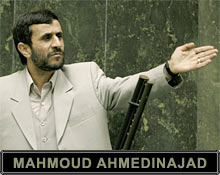
This ties into Purim specifically because Haman is a descendant of Amalek. G-d commanded the Jews to wipe out all of Amalek's nation and all that belonged to them, but they did not, and a few thousand years later, in Persia, a Hitlerian figure rose to power and was respected by the Persian king Achasverosh (Ahasuerus, or Xerxes) and found a way to annihilate the entire Jewish population in the Persian Empire. The Talmudic commentary explains that what could have been an act of mercy towards the Amalekites caused as much bloodshed as it did, which would have been avoided had the Jews carried out the command as it was given. An eerie, yet chanceful occurrence that today's "prince of Persia," the Iranian president Mahmoud Ahmedinajad, is also calling for an annihilational program for the Jewish people, in the form of a nuclear attack on the State of Israel.
Is there a familial, or biological, tie between Amalek, Haman, and Ahmedinajad? Such a thing would be extremely difficult in determining, but one thing is for sure, that we cannot buy into the standpoint that G-d is not acting or withdrawn, or that things occur only by chance; today Amalek is manifested in a viewpoint that attributes everything to humanity and nothing to G-d, and as Jews, we cannot ingest this worldview. That is how Amalek sees things, and it is not how the Jews should see things.



What is Amalek, what is he all about? The Torah says that Amalek had no regard for G-d at all.
When the Jews were leaving Egypt, Amalek and his boys attacked the Yids from behind in an attempt to destroy them. Think about this, this takes a lot of chutzpah; in a place and time when G-d was making amazing things happen to the Jews in front of everyone's eyes, Amalek decided that this would nevertheless be an acceptable time to make an attack. It's not that Amalek did not understand that G-d was tangibly active in the lives of the Jewish people, he understood and saw that He was but did not care; it was a direct affront to G-d's Presence. He was basically saying, "Up yours."
Rabbi Brumer said an interesting thing about this parsha, he said that Amalek stands for random chance. In the parsha we see that Amalek, by chance, came upon the Jewish people; he did not see their trek as being under the control of any Divine Being such as G-d, rather, chance was their pilot.
How does this make sense? So big deal, so Amalek believed in chance, how big of a sin is that? This is how it made sense to me; Amalek was a person of a philosophy and worldview that said that there is no ruler to anything, that what's done is done and that nothing really causes this world to function the way that it does. In this world, it is no wonder that Amalek felt no qualms doing what he did, he did not perceive G-d to be a real force in the world, perhaps he thought that the miracles that just occurred were chance. Even if G-d did exist, it didn't figure at all in to how it reflected human actions, and so he attacked the Jews.
This ties into Purim specifically because Haman is a descendant of Amalek. G-d commanded the Jews to wipe out all of Amalek's nation and all that belonged to them, but they did not, and a few thousand years later, in Persia, a Hitlerian figure rose to power and was respected by the Persian king Achasverosh (Ahasuerus, or Xerxes) and found a way to annihilate the entire Jewish population in the Persian Empire. The Talmudic commentary explains that what could have been an act of mercy towards the Amalekites caused as much bloodshed as it did, which would have been avoided had the Jews carried out the command as it was given. An eerie, yet chanceful occurrence that today's "prince of Persia," the Iranian president Mahmoud Ahmedinajad, is also calling for an annihilational program for the Jewish people, in the form of a nuclear attack on the State of Israel.
Is there a familial, or biological, tie between Amalek, Haman, and Ahmedinajad? Such a thing would be extremely difficult in determining, but one thing is for sure, that we cannot buy into the standpoint that G-d is not acting or withdrawn, or that things occur only by chance; today Amalek is manifested in a viewpoint that attributes everything to humanity and nothing to G-d, and as Jews, we cannot ingest this worldview. That is how Amalek sees things, and it is not how the Jews should see things.


Thursday, March 09, 2006
So in class today, I and my group gave a presentation about American Jews. After the presentation, the class was opened to questions. Our teacher asked me a question regarding the term "Political anti-Semitism." Her question to me was if political anti-Semitism was really a wild card term for opposition to Israel's policies, under the guise of anti-Semitism. I brought up two points. The first point was that, like all other forms of anti-Semitism from the past (religious and racial) that proponents of anti-Semitism always had a logical and rational reason to hold that view. The second point was that proponents of the anti-Israel view never isolate Israel's policies for rejection, rather, they isolate all of Israel and the very fact that it exists - since Jews live there, and since Israel is a Jewish endeavour, this is anti-Semitism.
Then a man in the back asked me a question about the Jewish nature of the State of Israel. He asked what "Jewish nature" means, and I answered that it means having a Jewish government, Jewish majority, and Jewish laws. "Jewish nature" means the same thing as Jordan's Muslim nature and Denmark's Christian nature. After the class, we continued the conversation outside when he told me that he wasn't entirely convinced. I told him that every country in the world has a dominant cultural, social, or religious group, and if someone attacks Israel on the basis of it having a Jewish majority, then that it is racism, and since racism towards Jews is anti-Semitism, being anti-Israel is being anti-Semitic.
Understanding this more deeply, anti-Israelism has its own name; "Anti-Israelism." There are people that have problems with country's policies, but they never call for their active dissasembly. There are people that loathe Jordanians and can't stand Danish people, but that doesn't make them "anti-Jordanian" or "anti-Danish," it just makes them racist, and they don't wish the state to be dissasembled to cure their hateful itch. With Israel it's different; hatred of Jews allows for calls to dismantle the State of Israel. In normal cases, even racists understand that their hatred of a particular people does not require them to call for the dismantling of a country, but with Israel it's a unique case; hatred of Jews is not enough, Jews should also should be stripped of their right to sovereignty. Israel's case is truly unique because the Jews' case is truly unique.
Racism against anybody is essentially the same, but here we see that there is a particularly disturbing component to anti-Semitism that perhaps other forms of racism do not contain. Your "normal racist" simply wants the subject of his loathing to be far away from him; he does not care if the hated people go somewhere else and "disappear." A Jew-hater, however, does not feel it enough that Jews relocate, he wants to see them fail, he actually is inspired to follow their movements, like a snake, wherever they go. It is for this reason that Israel is targeted; it was not enough that the Jews left Europe and the Arab countries, where they were not wanted, now there are people that want them to be terrorized in the country that they live, most ironically, Europeans and Arabs make up the crux of those people -- their "descendants."
The arguments that some people bring up about Israel reject its sovereignty, not its policies. Like all other forms of hate and racism, those who hate Israel find rationalistic ways to reject Israel through rejection of its policies. This manifests itself in their advocacy of policies that will work to undermind Israel's security and sovereignty. For example, if someone calls for the "right of return" of all Arabs forced to leave Israel in its war of inception, they are calling for a policy that will topple the Jewish demography of Israel and will create an Arab majority. In other words, it will destroy Israel. Either they are aware of the consequences and wish to see them occur, or they are painfully ignorant and blindly latching onto a cause of hate. Most ironically, this will turn Israel into an Arab state, and why should an Arab state have the right to exist and not a Jewish state? This becomes an even sillier question when we look at a map of one Jewish state and twenty three Muslim states; why should it be a ration of twenty four to zero?
Furthermore, Eritreans and Ethiopians, for example, who are locked in a battle of land ownership and ethnic and linguistic differnces, do not demand the dismantling of the neighboring country, rather, their deep divides are based on where the proper borders should be - they can't stand each other, and they even reject the way into the other country came into existence, but they do not believe that it should cease to exist. To contrast this, the Palestinians, the Arabs, and all those who latch on to "their cause," usually in a painfully ignorant manner, don't refer to where Israel's borders should be, rather, they proudly raise the question as to if Israel should have any borders, because a country that should not exist should have no borders. As it is, Israel is an illegal state and so was its formation; this is their argument.
Then a man in the back asked me a question about the Jewish nature of the State of Israel. He asked what "Jewish nature" means, and I answered that it means having a Jewish government, Jewish majority, and Jewish laws. "Jewish nature" means the same thing as Jordan's Muslim nature and Denmark's Christian nature. After the class, we continued the conversation outside when he told me that he wasn't entirely convinced. I told him that every country in the world has a dominant cultural, social, or religious group, and if someone attacks Israel on the basis of it having a Jewish majority, then that it is racism, and since racism towards Jews is anti-Semitism, being anti-Israel is being anti-Semitic.
Understanding this more deeply, anti-Israelism has its own name; "Anti-Israelism." There are people that have problems with country's policies, but they never call for their active dissasembly. There are people that loathe Jordanians and can't stand Danish people, but that doesn't make them "anti-Jordanian" or "anti-Danish," it just makes them racist, and they don't wish the state to be dissasembled to cure their hateful itch. With Israel it's different; hatred of Jews allows for calls to dismantle the State of Israel. In normal cases, even racists understand that their hatred of a particular people does not require them to call for the dismantling of a country, but with Israel it's a unique case; hatred of Jews is not enough, Jews should also should be stripped of their right to sovereignty. Israel's case is truly unique because the Jews' case is truly unique.
Racism against anybody is essentially the same, but here we see that there is a particularly disturbing component to anti-Semitism that perhaps other forms of racism do not contain. Your "normal racist" simply wants the subject of his loathing to be far away from him; he does not care if the hated people go somewhere else and "disappear." A Jew-hater, however, does not feel it enough that Jews relocate, he wants to see them fail, he actually is inspired to follow their movements, like a snake, wherever they go.
 It is for this reason that Israel is targeted; it was not enough that the Jews left Europe and the Arab countries, where they were not wanted, now there are people that want them to be terrorized in the country that they live, most ironically, Europeans and Arabs make up the crux of those people -- their "descendants."
The arguments that some people bring up about Israel reject its sovereignty, not its policies. Like all other forms of hate and racism, those who hate Israel find rationalistic ways to reject Israel through rejection of its policies. This manifests itself in their advocacy of policies that will work to undermind Israel's security and sovereignty. For example, if someone calls for the "right of return" of all Arabs forced to leave Israel in its war of inception, they are calling for a policy that will topple the Jewish demography of Israel and will create an Arab majority. In other words, it will destroy Israel. Either they are aware of the consequences and wish to see them occur, or they are painfully ignorant and blindly latching onto a cause of hate. Most ironically, this will turn Israel into an Arab state, and why should an Arab state have the right to exist and not a Jewish state? This becomes an even sillier question when we look at a map of one Jewish state and twenty three Muslim states; why should it be a ration of twenty four to zero?
Furthermore, Eritreans and Ethiopians, for example, who are locked in a battle of land ownership and ethnic and linguistic differnces, do not demand the dismantling of the neighboring country, rather, their deep divides are based on where the proper borders should be - they can't stand each other, and they even reject the way into the other country came into existence, but they do not believe that it should cease to exist. To contrast this, the Palestinians, the Arabs, and all those who latch on to "their cause," usually in a painfully ignorant manner, don't refer to where Israel's borders should be, rather, they proudly raise the question as to if Israel should have any borders, because a country that should not exist should have no borders. As it is, Israel is an illegal state and so was its formation; this is their argument.
Wednesday, March 08, 2006
- I found this on a thread, and I can't get rid of this dot.
- I'm disappointed its not there any more. I liked your cockroaches example, and being serious: Who likes cockroaches ?: Christ did, and in a very reverent way He became one, just to save us. The Eternal Hands of Omnipotence were humbled by God to become the tiny hands of a vunerable and helpless baby. Those hands and wrists ended up growing bigger just to have nails driven through them: What did He ever do on anyone??? There is an answer, NOTHING AT ALL except to heal them, love them and then die for them (don't think that merits murder on a cross) unfortuately this world does think that the Lord of Glory and Love merited murder.
'They hated Me without a cause' Jesus Christ. -Here we have 'unconditional' hatred.
You are right about the creation statement, you said what i meant but you said it better and clearer and in a lot less words. All the best.
-
I find this little discussion interesting. The way I see it, if G-d created the entire universe, and let's say that He also made other life forms in very distant sectors of it, and that He also made with them with the ability to connect to Him as He did with us, then He probably also gave them a code of life to live by as He did for us, a code that would represent His holiness.
However, this brings up a problem, did Jesus, the human Jew on this planet, also die for the sins of all of the creatures in the rest of the universe, or did G-d sent one of their "Jewish beings" to die for their sins? Does He have sons scattered all over the universe that happen to look like the species from which they come?
Another thing; perhaps this is precisely why G-d commanded humanity (in the Torah) not to make images of Him, because what does G-d really look like? What would intelligent beings on other planets imagine G-d, or "His son" to look like, as one of them? Sure, for Christians (and I'm a practicing Jew) it's easy to imagine G-d, and therefore Jesus, as having human physical characteristics, but what about the K-Paxians, did they also imagine G-d in their image? Any culture that imagines G-d, or the Divine in their image, or in an image of something that they can physically see (which is what the various polytheists did) miss an essential point of truth about G-d, that He is not a physical Being.
And one last thing; Christians believe that Jesus redeemed them from the "burden" of the Law, but if we look at the development of Christianity, we see that a law of sorts is developed based on the commandments of Jesus. Whoa, wait a minute; commandments = Law, the Law of Jesus? He is believed to have died to remove sin, and since a sin is a trangression of a commandment, his death also nullified his OWN commandments. In other words, Christians don't need to listen to the things that Jesus instructed, it doesn't matter what Jesus said, and as far as what he did (what would Jesus do?), are all Christians required to die like he did? Christianity, if we speak about it logically, is only concerned with Jesus' death, not his life, not what he said, and not what he instructed. It's through his death that they believe they are saved, not by his commandments.
Anyway, here's a link to the video that apparently began the conversation.
http://www.metacafe.com/watch/34650/ufo_in_new_york/
Saturday, March 04, 2006
Inability to Distinguish Truth from False
When I was younger and I would take "true false" quizzes, my teacher told us not to deliberately write the "T" or the "F" so that it would be hard to distinguish between them. She told us not to do this because she thought that some kids would to do this in order to force her from marking it wrong due to inability to tell what it actually said. They would do this by writing a "T," erasing it, writing an "F," erasing it, and continuing the process until the "T" and the "F" looked indiscernable.
Today we live in a world where we cannot tell the difference between many "T's" and "F's," sometimes what we see is ambiguous and hard to discern. Furthermore, many human minds are caught in this cloud of illusion, which still allows them to see truth, but only through this smokescreen; one of these smokescreens is "romanticism."
Take the following paragraph in the book titled, "Arab and Jew" by David Shipler. I've only gotten through a part of the book, but I can already tell that the author views the nature of the conflict between the "Arab and Jew" as a romanticized nightmare of mutual ongoing vengeance and hatred; this is incredibly inaccurate. The paragraph was not written by Shipler himself, but Alexander Finkelshtein, the author of this quote, said, regarding "the fighting in Lebanon unfold,"
"I felt myself like a split personality. I was running with the soldiers and cleaning up the area, and I felt myself standing with the civilian population, without water, without shelter. I had my flashbacks. And please understand me: I know the difference between what was done to Jews and to Palestinians. But there are two pictures in my mind, one of Palestinian children advancing with their hands up. You have seen the picture of the children advancing with their hands up. You have seen the picture of the children in the Warsaw Ghetto. Another, of an Arab woman in shell shock, holding the hand of a soldier. The Israeli soldier gave her water. She wouldn't let go of his hand. Take this soldier. He will never return the same man he was. And this Arab man. He could be my father. And I can't look at him like my enemy. You will enter a vicious circle, blood for blood, and at the end you cannot remember where was the beginning. And you are not more just than the other side. We now look like every other nation."
What a tragic paragraph full of fallacies; where do I even start in pointing them out?!
A picture is worth one thousand words, but it can also be worth a thousand misunderstandings; this is the problem with viewing without thinking. The context of the Warsaw Ghetto, as he explains himself, was different from what "was happening to the Palestinians," and he knew that, but his own emotions obstructed him from seeing this difference. This is not entirely bad in itself, for terror is terror, but in the case of an unnecessarily troubled Jewish psyche, it causes a Jew to humanize his enemy, who is really trying to kill him, by dehumanizing himself to the point where he parallels himself with the demonic memory of he who tried to annihilate him, Hitler. This is an unhealthy emotional and psychological response, a response to intense trauma, and perhaps some idealistic wishful thinking about a fanciful Messianic age between Arabs who want us gone and Jews who want to stay.
True, in war, it is of utmost important to regard the humanity of your enemy, and especially of those who are not involved in combat. Therefore, it was right of him to view the Arab man and woman non-combatants as people (his parents), but at the same time, it is not unrelated to his fanciful romantic notion of peace, which won't achieve peace, but will achieve his destruction by allowing him to view the real enemy, the Arabs with the guns and false peace treaties, as "his brothers." The vicious circle he refers exists not in the combat with these killers, but in his own confused psyche and emotional inambiguity, going back and forth between "T" and "F" and not allowing him to see the difference.
The Torah says that Adam, before he ate from the fruit of the Tree of Knowledge between Good and Evil, did not judge things as either "good" or "evil," but rather, between "true" and "false." He who erases the "T" and "F" over and over again until they are indiscernable is the "yetzer harah," the evil inclination, or Satan. Just like the students did not want to be marked wrong, so too does he not want us to mark him wrong, so he meddles with the clarity of truth and falsehood until the two begin to resemble each other, and it is our job of utmost importance to distinguish between the two.
When I was younger and I would take "true false" quizzes, my teacher told us not to deliberately write the "T" or the "F" so that it would be hard to distinguish between them. She told us not to do this because she thought that some kids would to do this in order to force her from marking it wrong due to inability to tell what it actually said. They would do this by writing a "T," erasing it, writing an "F," erasing it, and continuing the process until the "T" and the "F" looked indiscernable.
Today we live in a world where we cannot tell the difference between many "T's" and "F's," sometimes what we see is ambiguous and hard to discern. Furthermore, many human minds are caught in this cloud of illusion, which still allows them to see truth, but only through this smokescreen; one of these smokescreens is "romanticism."
Take the following paragraph in the book titled, "Arab and Jew" by David Shipler. I've only gotten through a part of the book, but I can already tell that the author views the nature of the conflict between the "Arab and Jew" as a romanticized nightmare of mutual ongoing vengeance and hatred; this is incredibly inaccurate. The paragraph was not written by Shipler himself, but Alexander Finkelshtein, the author of this quote, said, regarding "the fighting in Lebanon unfold,"
"I felt myself like a split personality. I was running with the soldiers and cleaning up the area, and I felt myself standing with the civilian population, without water, without shelter. I had my flashbacks. And please understand me: I know the difference between what was done to Jews and to Palestinians. But there are two pictures in my mind, one of Palestinian children advancing with their hands up. You have seen the picture of the children advancing with their hands up. You have seen the picture of the children in the Warsaw Ghetto. Another, of an Arab woman in shell shock, holding the hand of a soldier. The Israeli soldier gave her water. She wouldn't let go of his hand. Take this soldier. He will never return the same man he was. And this Arab man. He could be my father. And I can't look at him like my enemy. You will enter a vicious circle, blood for blood, and at the end you cannot remember where was the beginning. And you are not more just than the other side. We now look like every other nation."
What a tragic paragraph full of fallacies; where do I even start in pointing them out?!
A picture is worth one thousand words, but it can also be worth a thousand misunderstandings; this is the problem with viewing without thinking. The context of the Warsaw Ghetto, as he explains himself, was different from what "was happening to the Palestinians," and he knew that, but his own emotions obstructed him from seeing this difference. This is not entirely bad in itself, for terror is terror, but in the case of an unnecessarily troubled Jewish psyche, it causes a Jew to humanize his enemy, who is really trying to kill him, by dehumanizing himself to the point where he parallels himself with the demonic memory of he who tried to annihilate him, Hitler. This is an unhealthy emotional and psychological response, a response to intense trauma, and perhaps some idealistic wishful thinking about a fanciful Messianic age between Arabs who want us gone and Jews who want to stay.
True, in war, it is of utmost important to regard the humanity of your enemy, and especially of those who are not involved in combat. Therefore, it was right of him to view the Arab man and woman non-combatants as people (his parents), but at the same time, it is not unrelated to his fanciful romantic notion of peace, which won't achieve peace, but will achieve his destruction by allowing him to view the real enemy, the Arabs with the guns and false peace treaties, as "his brothers." The vicious circle he refers exists not in the combat with these killers, but in his own confused psyche and emotional inambiguity, going back and forth between "T" and "F" and not allowing him to see the difference.
The Torah says that Adam, before he ate from the fruit of the Tree of Knowledge between Good and Evil, did not judge things as either "good" or "evil," but rather, between "true" and "false." He who erases the "T" and "F" over and over again until they are indiscernable is the "yetzer harah," the evil inclination, or Satan. Just like the students did not want to be marked wrong, so too does he not want us to mark him wrong, so he meddles with the clarity of truth and falsehood until the two begin to resemble each other, and it is our job of utmost importance to distinguish between the two.
I'm going to start a new Jew-is-beautiful tradition, I'm going to write down a short dvar Torah that I heard this Shabbat.
This one was made by my friend Tom with regards to something that this high school track coach made back in the day. You see, Tom used to be a runner in high school, and one day Tom ran a race without his proper running clothes, and the coach got on his case about the importance of wearing the right clothing for the purpose that they have the needed positive effect on the attitude of the runner. He tied this in to the precise measurements that G-d gave Moses to make the Mishkan, Aron, and all of the other constructions necessary; everything had to appear a certain way, which was a testament that each arrangement in the Mishkan had a specific meaning. Yasher ko'ach, Tom!
This one was made by my friend Tom with regards to something that this high school track coach made back in the day. You see, Tom used to be a runner in high school, and one day Tom ran a race without his proper running clothes, and the coach got on his case about the importance of wearing the right clothing for the purpose that they have the needed positive effect on the attitude of the runner. He tied this in to the precise measurements that G-d gave Moses to make the Mishkan, Aron, and all of the other constructions necessary; everything had to appear a certain way, which was a testament that each arrangement in the Mishkan had a specific meaning. Yasher ko'ach, Tom!
Wednesday, March 01, 2006
A Democracy is.........
I just saw a bumper sticker reading, "A democracy is measured by the rights you afford dissidents, not by the rights you afford assimilated conformists," and it was made by a woman named "Abbie Hoffman," and I am not sure who she is.
The problem is, she's wrong; a democracy is measured by the rights you afford to everyone, for if a democracy afforded rights only to its dissidents and not its "assimilated conformists," which I guess is a euphemism for "people who agree," then you would have a totalitarian regime, the kind you have in the West Bank or the Gaza Strip with the dissident Hamas running amok.
I just saw a bumper sticker reading, "A democracy is measured by the rights you afford dissidents, not by the rights you afford assimilated conformists," and it was made by a woman named "Abbie Hoffman," and I am not sure who she is.
The problem is, she's wrong; a democracy is measured by the rights you afford to everyone, for if a democracy afforded rights only to its dissidents and not its "assimilated conformists," which I guess is a euphemism for "people who agree," then you would have a totalitarian regime, the kind you have in the West Bank or the Gaza Strip with the dissident Hamas running amok.
Tuesday, February 28, 2006
Touching G-d
So basically it's like this. Just as one can touch a physical, tangible object with his hand, so one can touch a mental "object" with his mind. For example, a person can rest his hand on a table; he is putting one physical thing into contact with another. How can a person put himself or herself into contact with G-d when He is Invisible and not something that we can detect with any of our physical senses? How can physical beings such as ourselves come into contact with G-d, a purely spiritual Being? How can we be even sure that He exists? This can be answered by trying to answer the question, "What am I?"
The answer is pretty simple. First we have to answer the question, "Can I percieve my self?" Am I able to say that, yes, I am definitely present, that I am definitely here? Not many people will say that they do not exist, for at the center of existence is perception. The body is the only part of me that I can see, and therefore it is no problem to conclude that it exists. However, physical sensations are invisible, but my ability to feel them tells me that they exist without a doubt. When I touch an object, I am absolutely sure that it is really there.
Emotions themselves are invisible and untouchable, as well as the sensations that they register, yet we are absolutely sure that they are real because we are able to sense them. When I feel an emotion, I am absolutely sure that it is really there, I feel it with my heart in the way that a hand feels a table.
Our minds are definitely invisible, there is nothing that we can do to see our mind, yet it is absolutely clear that our mind exists because we can sense our own perceptions and can think about the outside world, the empirical world. In the way that a hand touches a table, and in the way that a heart touches an emotion, the mind touches an idea. Therefore, just as a table is real and exists independently, so too does an emotion really exist; it is not just a product of the heart's ability to feel it any more than a hand causes a table to exist. In the same way, an idea is real and is not created by the mind's ability to perceive it any more than a hand's existence causes the table to exist. It exists externally and it comes into contact with the mind.
Imagine if we were just a body. A body itself has no powers of perception other than nerves, it is an entity in and of itself; it is an inanimate object that was designed to be able to move; we see that a dead body feels nothing. A body is not the source of its own life; we know this because when a "person" dies, the body is motionless. Therefore, we understand that there is something beyond the body that gives it life. We can say that perhaps it is the brain, but the brain being a physical organ in and of itself, dies too, so we must wonder, what is the brain's source of life?
An emotion is a sensation that a living being has in response to a variety of internal and external stimuli, allowing living beings to interact with other living beings. But emotions also are not the source of a human's being life, because a particular state of being is not the same thing as the being itself. The emotions of the human, such as anger or joy, employ the body, such as with fighting or dancing, but they do not cause it to have life. If this was so, if emotions were the source of a human's life, when the emotions ended, so would life. Therefore, we can only conclude that there is something beyond emotions that endows a person with life.
The mind allows a living being to ponder his existence beyond both his body and his emotions, it allows him to center his attention outwards, while emotions only allow the being to consider his own internal status. Therefore, a being's emotions are not the source of his ability to connect with other beings, because they are purely internal, and even though other beings also have emotions, it is the mind that allows the being to consider that other beings also have emotions. In other words, your emotions can be directed towards other people, which is fascinating really, because emotions are completely self-serving tools; it is the mind that allows us to direct our emotions towards other living beings. Therefore, it is the mind that employs the emotions and the body in order to create relationships. But the mind is also not the source of life, because the mind is just the tool that makes sense of the internal and the external happenings; the mind does not give the person life by being able to think about that life. Unfortunately, there are mental disorders where a person's mind essentially disappears, such as schizophrenia and Alzheimer's, but the person does not cease to exist in such cases. Therefore, we have to conclude that the mind is not the source of a person's existence, or life; perception is not what makes us alive, because perception can end and life continues.
The soul serves as the human's true sense of self. It cannot be said that the body is "me," because I do not necessarily feel myself to exist in the way that my body looks. My emotions are not "me" because they are ever-changing, regardless of how I understand things. Rather, they are states that I exist in in response to external and internal stimuli. My mind is not "me," although I am able to perceive and understand things by using it, and my mind can be affected in powerful ways by the information that is put into it. However, no matter what information of any sort (ideas, music, imagery, relationships, sensations) I introduce into my mind, and no matter how powerfully my understanding of things is altered due to my mind's exposure to those things, I have a sense of self deep within me that is untouched and unaltered by those things. My existence is independent from those things that I expose myself to - my nature cannot be changed. Therefore, what I am cannot be changed, a soul cannot be altered by any internal or external presences. My body feels things, my emotions run wild, my mind travels to all kinds of places, but neither of them can change my soul, rather, the ways that they are used either allow, or keep me from, getting into touch with what I am, with revealing my soul, which is really me. I can only know myself by treating my body, emotions, and mind, with respect and care, and only then am I able to get in touch with my deepest self. Once I get in touch with my deepest self, the soul, then I am able to begin treating my soul with respect and care, I can begin to put my soul into contact with G-d, which means that I have to be mindful to treat my body, emotions, and mind, as tools of holiness. This requires that I pay attention to what I do with my body, what emotions I feel, and how and what I think. Only then can I alter my soul, it can only move upwards, not downwards. The mind, emotions, and body can move downards, distancing me from my soul, but when they move upwards, they move me closer to it, and when I contact it, I can move it upwards closer to G-d.
The soul is the source of life, but however, it is not the source of its own life, because it also does not make sense that the soul willed itself into existence. Therefore, we understand that the soul was "made" by G-d, that G-d put "some of Himself" into the human body, as Genesis states. The next "step up" is G-d Himself, He is above the soul, unknowable in absolution to the human being, but nevertheless entirely and deeply experiencable, since He made us from Himself. If we are a soul, then we are deeply and absolutely intimately a part of G-d Himself, we were made in His "image." G-d's "body," His "emotions," and His "mind," are the models for our body, emotions, and mind, and the soul is a piece of G-d.
You must put yourself into contact with G-d by touching Him with your soul. How do we move our soul? Since we are souls, we have to learn how to move, in the spiritual sense. We can move our bodies, we can move our emotions, we can move our minds, but how do we move? How do we move ourselves, how do "our souls" move? Once we can do that, we can move our soul towards G-d. We use the mitzvot, the commandments. G-d can move towards us, but He waits for us to make the first movement, otherwise His movement would perplex, shock, and damage us, as if our entire foundations were suddenly changing without our understanding or will for them to change. This is why G-d gave us free will, once we desire it, it can happen. When we walk down that path, it happens, we see G-d as a direct function of the input.
The sages of the Talmud say that we must first control our bodies, emotions, and minds, and only then do our souls bring G-d into focus, and we begin to "see" Him. However, people today cannot do this on their own, or at least only a superminority of humanity can do this, which is the reason that G-d gave us the commandments, they allow us to near G-d, they teach us how to put our bodies, emotions, minds, and souls into contact with Him without having the ability to find out how on our own. Only Abraham was able to derive the commandments from within himself, but the supermajority of us have no clue how to do that.
Through our souls, we can see G-d. Where do we see Him? Since we control our bodies, our emotions, and our minds before we see G-d, we begin to see all of these things as being of G-d; we don't see G-d in them, we see them in G-d. It is then that we see our soul as being a part of G-d; we no longer see it as something that comes into contact with G-d, we understand that it, that I, that the person, is a part of G-d, that while we are we, while we are individuals, that we are seemlessly connected to G-d. The Kabbalah speaks of this process as removing the layers from an onion. When we use our bodies, emotions, and minds properly, we strip away the layers and reveal our souls, and shortly after, we reveal G-d.
G-d can do this on His own, as He has done it a few times in the Torah, but it would be in vain for Him to do it for us. Not only would it be in vain, it would be damaging, for the sudden revelation of G-d to a human, His sudden peeling back of all of the layers, skipping the process, would be extremely violent and would sent a human being into a state of shock and would probably kill him or mame him. Therefore, nearing G-d needs to be a process, not sudden and instant. Indeed, when G-d gave the Torah to the Jews, He revealed Himself to them all, and they all saw Him, without being ready. When they saw Him, they yelled to Moses, "Let us not near the foot of the mountain, lest we see G-d and die!" At the giving of the Torah, it is reported that all who were there experienced prophecy, and that they "heard lightning" and "saw thunder";the natural world itself was shattering as G-d was revealing Himself to them. This is why G-d keeps Himself "hidden" from the world. Every individual contains both the internal ability and the external commandments to expose this revelation of G-d, and He is waiting there "on the other side" for us to reveal Him, ever patiently, and when we do this, He shows Himself to us.
G-d is a figment of our imagination
A little "philosophical" nugget for the night, and I would appreciate any feedback that ya'll have on this. To cut to the chase - is it possible that G-d is really a function of the human's mind to believe that He exists, trumping if He really exists or not? Is the belief that G-d exists more important than His existence? Therefore, if G-d did not really exist, it wouldn't matter, because the belief would be more important than the fact.
Maybe G-d is an illusion of the mind. This idea is actually more far-fetched than the supposedly far-fetched belief in the existence of G-d.
Let us assume that G-d was a figment of the mind, that the mind was able to produce a notion that He exists, but which negates His actual existence. For example, it would be like wearing glasses to make your eyesight better, but which also made you see things that weren't really there. Your eyesight was improving, but you also saw things that did not really exist. If somebody sold me glasses like that, I should want my money back!
As it is, G-d is not fully knowable to the human mind; He is an absolute Being, and our knowledge of Him can always be only finite and in line with our abilities to understand. Think about it, it would be a dauntingly complex process -- the mind creates an idea of G-d that is only partially knowable so that it fools a person into thinking that G-d actually exists but is not totally knowable. As the person comes to know G-d more and on deeper levels, the mind gradually removes its own barriers and develops the idea.
This would require the brain to have infinite abilities, beyond the consciousness of the individual, meaning that the mind has a degree of independence from the human that possesses it. If the human being was in charge of his mind's own growth, it would require him to master all areas of his brain so that he could allow it to leak information to him as he became ready and to believe that he was not in control.
The information that a person’s brain records cannot come together in a coherent whole if the person does not believe that there is a pervasive unity to all that exists. If there was no unity in all that exists, then all information, and everything that exists, would exist in discordance with everything else, and eco-systems, for example, would be impossible. In an eco-system, everything is related in some intricate way; in the same vein, the entire world is an eco-system, and in a world where concepts exist and not just physical objects, we must have an eco-system of concepts.
Nobody can deny the importance of an eco-system, and it is hard to deny the importance of understanding the function of the parts in the eco-system in their relation to the whole. It would be equally foolish to conclude that there is no whole, that only the parts exist. This discordant view would cause the world to fall apart, which is why every religious and philosophical system believes in a coherent whole. Perhaps evolution can be credited for creating the physical world’s eco-system, but we cannot credit evolution for its creation of the need for a conceptual eco-system. Even if everything is united, if the parts “just happened to fall together perfectly” and were not put together, then nothing would keep them from falling apart. If the forces that created this world and the order in it were random, then they could just as easily randomly cease to function, but this hasn’t happened yet.
Thinking that G-d exists because humans desire Him to exist, would be like creating and programming a computer to help you with life's most difficult problems, but to cause yourself to forget that you were the one that programmed it in the first place. In reality, since you were the one that programmed the computer, you don't really need it because all the information that it contains, it contains because you contained it and programmed it likewise. It would be far more feasible to believe that the computer really did know everything, and that it was programmed by somebody much more knowledgable than you. The former concept is incredibly far-fetched because we are still discovering basic functions of the brain itself - it would be impossible to say that we, as human beings, endowed the brain with all of the information that it has. It is more logical to believe that something else created the brain, which we already believe was evolution.
It would be rediculous and impossible to conclude that G-d is a figment of our imagination. This would mean that the mind is, as we go along, inventing an infinite, perfect, and absolute notion of G-d, and as we near understanding more, it invents more information to make accessible to us, and it does so completely arbitrarily! If the brain was actually able to create a perfect idea and to contain it in an accessible lobe, then the brain would be G-d!
This is an eery notion that says that, somehow, every brain is made in the same way with the same abilities, and that tabs are kept on each brain in order to know when to give it more information; it is as if each brain were hooked into a "Matrix" of sorts, and observed all the time by an external consciousness, which acted upon it from time to time. It says that each brain is actually part of a bigger brain and that each human being has a section of that brain in his or her head; it says that we are all hooked into a Matrix. Somewhere, there is a huge brain just sitting and thinking, a huge conscious, intelligent, brain, and we are just mini-brains with bodies. Our brain (the one in our head) would have to be "more infinite" than the (supposedly) infinite ideas it leaked into our minds. In other words, if the brain was able to complete such a daunting and complicated task, it would have to have unlimited and unrestricted access to information, and the ability to leak information to us as it wanted, and yes, it would also have to posses free will, the ability to decide - it would have to have a mind of its own, a connection to a mainframe.
If brains had minds, i.e., they would not be under our control, it would render any creature with a brain a hopelessly schizophrenic being. This is not too far-fetched, for our brain takes care of the majority of our body's functions, such as digestion, breathing, keeping us alive while we sleep, and causing us to drop hot things, and we have absolutely nothing to do with these things. Our body is truly schizophrenic, but this is normal. The brain takes care of all of these tasks independently and without our permission, but we are incredibly thankful (or at least we should be), so can we say that the brain has a mind of its own?
Indeed, this is what certain types of scientists say about G-d, that it is a schizophrenic but distinctly human voice inside the head. Interestingly enough, they do not say that the body's functioning is a product of the human's desire for it to function! Is digestion a figment of our imagination in the same way that the brain's mental functions are?! The brain's physical functions are automatic and necessary, but the brain's mental functions are not! Is this not a physical age?! Does digestion occur because we wish for it to occur? If so, we would be dead by now, because we have other things to do than worry about making our bodies carry out vital functions; we wouldn't have gotten so far evolutionary if we had to spend all day long thinking about making our body's work.
Scientists do not say that our body is schizophrenic, rather, they exalt and revere its amazing abilities, but at the same time brand belief in G-d as schizophrenic, and primitive. Is the body's primitiveness not the its key to survival? Perhaps "primitive" is the wrong word, perhaps "simplicity" is more accurate. All of this smacks of intelligent design.
We have not even begun to tap into the full potentials of the brain, so the notion that the brain somehow is a carrier of dense amounts of information is not far-fetched at all, and it is a wonder if we will ever be able to approach the horizon of the brain's outerlimits. It is hard to imagine that evolution has created such an organ through random chance alone. People who assert that G-d is a figment of the mind's imagination, probably unknowingly, are buying into this theory without realizing how impossible it really is; it is more likely that G-d exists, and it leaves the former alternative unbelievable and full of superstition and the latter starkly believable and rational.
So basically it's like this. Just as one can touch a physical, tangible object with his hand, so one can touch a mental "object" with his mind. For example, a person can rest his hand on a table; he is putting one physical thing into contact with another. How can a person put himself or herself into contact with G-d when He is Invisible and not something that we can detect with any of our physical senses? How can physical beings such as ourselves come into contact with G-d, a purely spiritual Being? How can we be even sure that He exists? This can be answered by trying to answer the question, "What am I?"
The answer is pretty simple. First we have to answer the question, "Can I percieve my self?" Am I able to say that, yes, I am definitely present, that I am definitely here? Not many people will say that they do not exist, for at the center of existence is perception. The body is the only part of me that I can see, and therefore it is no problem to conclude that it exists. However, physical sensations are invisible, but my ability to feel them tells me that they exist without a doubt. When I touch an object, I am absolutely sure that it is really there.
Emotions themselves are invisible and untouchable, as well as the sensations that they register, yet we are absolutely sure that they are real because we are able to sense them. When I feel an emotion, I am absolutely sure that it is really there, I feel it with my heart in the way that a hand feels a table.
Our minds are definitely invisible, there is nothing that we can do to see our mind, yet it is absolutely clear that our mind exists because we can sense our own perceptions and can think about the outside world, the empirical world. In the way that a hand touches a table, and in the way that a heart touches an emotion, the mind touches an idea. Therefore, just as a table is real and exists independently, so too does an emotion really exist; it is not just a product of the heart's ability to feel it any more than a hand causes a table to exist. In the same way, an idea is real and is not created by the mind's ability to perceive it any more than a hand's existence causes the table to exist. It exists externally and it comes into contact with the mind.
Imagine if we were just a body. A body itself has no powers of perception other than nerves, it is an entity in and of itself; it is an inanimate object that was designed to be able to move; we see that a dead body feels nothing. A body is not the source of its own life; we know this because when a "person" dies, the body is motionless. Therefore, we understand that there is something beyond the body that gives it life. We can say that perhaps it is the brain, but the brain being a physical organ in and of itself, dies too, so we must wonder, what is the brain's source of life?
An emotion is a sensation that a living being has in response to a variety of internal and external stimuli, allowing living beings to interact with other living beings. But emotions also are not the source of a human's being life, because a particular state of being is not the same thing as the being itself. The emotions of the human, such as anger or joy, employ the body, such as with fighting or dancing, but they do not cause it to have life. If this was so, if emotions were the source of a human's life, when the emotions ended, so would life. Therefore, we can only conclude that there is something beyond emotions that endows a person with life.
The mind allows a living being to ponder his existence beyond both his body and his emotions, it allows him to center his attention outwards, while emotions only allow the being to consider his own internal status. Therefore, a being's emotions are not the source of his ability to connect with other beings, because they are purely internal, and even though other beings also have emotions, it is the mind that allows the being to consider that other beings also have emotions. In other words, your emotions can be directed towards other people, which is fascinating really, because emotions are completely self-serving tools; it is the mind that allows us to direct our emotions towards other living beings. Therefore, it is the mind that employs the emotions and the body in order to create relationships. But the mind is also not the source of life, because the mind is just the tool that makes sense of the internal and the external happenings; the mind does not give the person life by being able to think about that life. Unfortunately, there are mental disorders where a person's mind essentially disappears, such as schizophrenia and Alzheimer's, but the person does not cease to exist in such cases. Therefore, we have to conclude that the mind is not the source of a person's existence, or life; perception is not what makes us alive, because perception can end and life continues.
The soul serves as the human's true sense of self. It cannot be said that the body is "me," because I do not necessarily feel myself to exist in the way that my body looks. My emotions are not "me" because they are ever-changing, regardless of how I understand things. Rather, they are states that I exist in in response to external and internal stimuli. My mind is not "me," although I am able to perceive and understand things by using it, and my mind can be affected in powerful ways by the information that is put into it. However, no matter what information of any sort (ideas, music, imagery, relationships, sensations) I introduce into my mind, and no matter how powerfully my understanding of things is altered due to my mind's exposure to those things, I have a sense of self deep within me that is untouched and unaltered by those things. My existence is independent from those things that I expose myself to - my nature cannot be changed. Therefore, what I am cannot be changed, a soul cannot be altered by any internal or external presences. My body feels things, my emotions run wild, my mind travels to all kinds of places, but neither of them can change my soul, rather, the ways that they are used either allow, or keep me from, getting into touch with what I am, with revealing my soul, which is really me. I can only know myself by treating my body, emotions, and mind, with respect and care, and only then am I able to get in touch with my deepest self. Once I get in touch with my deepest self, the soul, then I am able to begin treating my soul with respect and care, I can begin to put my soul into contact with G-d, which means that I have to be mindful to treat my body, emotions, and mind, as tools of holiness. This requires that I pay attention to what I do with my body, what emotions I feel, and how and what I think. Only then can I alter my soul, it can only move upwards, not downwards. The mind, emotions, and body can move downards, distancing me from my soul, but when they move upwards, they move me closer to it, and when I contact it, I can move it upwards closer to G-d.
The soul is the source of life, but however, it is not the source of its own life, because it also does not make sense that the soul willed itself into existence. Therefore, we understand that the soul was "made" by G-d, that G-d put "some of Himself" into the human body, as Genesis states. The next "step up" is G-d Himself, He is above the soul, unknowable in absolution to the human being, but nevertheless entirely and deeply experiencable, since He made us from Himself. If we are a soul, then we are deeply and absolutely intimately a part of G-d Himself, we were made in His "image." G-d's "body," His "emotions," and His "mind," are the models for our body, emotions, and mind, and the soul is a piece of G-d.
You must put yourself into contact with G-d by touching Him with your soul. How do we move our soul? Since we are souls, we have to learn how to move, in the spiritual sense. We can move our bodies, we can move our emotions, we can move our minds, but how do we move? How do we move ourselves, how do "our souls" move? Once we can do that, we can move our soul towards G-d. We use the mitzvot, the commandments. G-d can move towards us, but He waits for us to make the first movement, otherwise His movement would perplex, shock, and damage us, as if our entire foundations were suddenly changing without our understanding or will for them to change. This is why G-d gave us free will, once we desire it, it can happen. When we walk down that path, it happens, we see G-d as a direct function of the input.
The sages of the Talmud say that we must first control our bodies, emotions, and minds, and only then do our souls bring G-d into focus, and we begin to "see" Him. However, people today cannot do this on their own, or at least only a superminority of humanity can do this, which is the reason that G-d gave us the commandments, they allow us to near G-d, they teach us how to put our bodies, emotions, minds, and souls into contact with Him without having the ability to find out how on our own. Only Abraham was able to derive the commandments from within himself, but the supermajority of us have no clue how to do that.
Through our souls, we can see G-d. Where do we see Him? Since we control our bodies, our emotions, and our minds before we see G-d, we begin to see all of these things as being of G-d; we don't see G-d in them, we see them in G-d. It is then that we see our soul as being a part of G-d; we no longer see it as something that comes into contact with G-d, we understand that it, that I, that the person, is a part of G-d, that while we are we, while we are individuals, that we are seemlessly connected to G-d. The Kabbalah speaks of this process as removing the layers from an onion. When we use our bodies, emotions, and minds properly, we strip away the layers and reveal our souls, and shortly after, we reveal G-d.
G-d can do this on His own, as He has done it a few times in the Torah, but it would be in vain for Him to do it for us. Not only would it be in vain, it would be damaging, for the sudden revelation of G-d to a human, His sudden peeling back of all of the layers, skipping the process, would be extremely violent and would sent a human being into a state of shock and would probably kill him or mame him. Therefore, nearing G-d needs to be a process, not sudden and instant. Indeed, when G-d gave the Torah to the Jews, He revealed Himself to them all, and they all saw Him, without being ready. When they saw Him, they yelled to Moses, "Let us not near the foot of the mountain, lest we see G-d and die!" At the giving of the Torah, it is reported that all who were there experienced prophecy, and that they "heard lightning" and "saw thunder";the natural world itself was shattering as G-d was revealing Himself to them. This is why G-d keeps Himself "hidden" from the world. Every individual contains both the internal ability and the external commandments to expose this revelation of G-d, and He is waiting there "on the other side" for us to reveal Him, ever patiently, and when we do this, He shows Himself to us.
G-d is a figment of our imagination
A little "philosophical" nugget for the night, and I would appreciate any feedback that ya'll have on this. To cut to the chase - is it possible that G-d is really a function of the human's mind to believe that He exists, trumping if He really exists or not? Is the belief that G-d exists more important than His existence? Therefore, if G-d did not really exist, it wouldn't matter, because the belief would be more important than the fact.
Maybe G-d is an illusion of the mind. This idea is actually more far-fetched than the supposedly far-fetched belief in the existence of G-d.
Let us assume that G-d was a figment of the mind, that the mind was able to produce a notion that He exists, but which negates His actual existence. For example, it would be like wearing glasses to make your eyesight better, but which also made you see things that weren't really there. Your eyesight was improving, but you also saw things that did not really exist. If somebody sold me glasses like that, I should want my money back!
As it is, G-d is not fully knowable to the human mind; He is an absolute Being, and our knowledge of Him can always be only finite and in line with our abilities to understand. Think about it, it would be a dauntingly complex process -- the mind creates an idea of G-d that is only partially knowable so that it fools a person into thinking that G-d actually exists but is not totally knowable. As the person comes to know G-d more and on deeper levels, the mind gradually removes its own barriers and develops the idea.
This would require the brain to have infinite abilities, beyond the consciousness of the individual, meaning that the mind has a degree of independence from the human that possesses it. If the human being was in charge of his mind's own growth, it would require him to master all areas of his brain so that he could allow it to leak information to him as he became ready and to believe that he was not in control.
The information that a person’s brain records cannot come together in a coherent whole if the person does not believe that there is a pervasive unity to all that exists. If there was no unity in all that exists, then all information, and everything that exists, would exist in discordance with everything else, and eco-systems, for example, would be impossible. In an eco-system, everything is related in some intricate way; in the same vein, the entire world is an eco-system, and in a world where concepts exist and not just physical objects, we must have an eco-system of concepts.
Nobody can deny the importance of an eco-system, and it is hard to deny the importance of understanding the function of the parts in the eco-system in their relation to the whole. It would be equally foolish to conclude that there is no whole, that only the parts exist. This discordant view would cause the world to fall apart, which is why every religious and philosophical system believes in a coherent whole. Perhaps evolution can be credited for creating the physical world’s eco-system, but we cannot credit evolution for its creation of the need for a conceptual eco-system. Even if everything is united, if the parts “just happened to fall together perfectly” and were not put together, then nothing would keep them from falling apart. If the forces that created this world and the order in it were random, then they could just as easily randomly cease to function, but this hasn’t happened yet.
Thinking that G-d exists because humans desire Him to exist, would be like creating and programming a computer to help you with life's most difficult problems, but to cause yourself to forget that you were the one that programmed it in the first place. In reality, since you were the one that programmed the computer, you don't really need it because all the information that it contains, it contains because you contained it and programmed it likewise. It would be far more feasible to believe that the computer really did know everything, and that it was programmed by somebody much more knowledgable than you. The former concept is incredibly far-fetched because we are still discovering basic functions of the brain itself - it would be impossible to say that we, as human beings, endowed the brain with all of the information that it has. It is more logical to believe that something else created the brain, which we already believe was evolution.
It would be rediculous and impossible to conclude that G-d is a figment of our imagination. This would mean that the mind is, as we go along, inventing an infinite, perfect, and absolute notion of G-d, and as we near understanding more, it invents more information to make accessible to us, and it does so completely arbitrarily! If the brain was actually able to create a perfect idea and to contain it in an accessible lobe, then the brain would be G-d!
This is an eery notion that says that, somehow, every brain is made in the same way with the same abilities, and that tabs are kept on each brain in order to know when to give it more information; it is as if each brain were hooked into a "Matrix" of sorts, and observed all the time by an external consciousness, which acted upon it from time to time. It says that each brain is actually part of a bigger brain and that each human being has a section of that brain in his or her head; it says that we are all hooked into a Matrix. Somewhere, there is a huge brain just sitting and thinking, a huge conscious, intelligent, brain, and we are just mini-brains with bodies. Our brain (the one in our head) would have to be "more infinite" than the (supposedly) infinite ideas it leaked into our minds. In other words, if the brain was able to complete such a daunting and complicated task, it would have to have unlimited and unrestricted access to information, and the ability to leak information to us as it wanted, and yes, it would also have to posses free will, the ability to decide - it would have to have a mind of its own, a connection to a mainframe.
If brains had minds, i.e., they would not be under our control, it would render any creature with a brain a hopelessly schizophrenic being. This is not too far-fetched, for our brain takes care of the majority of our body's functions, such as digestion, breathing, keeping us alive while we sleep, and causing us to drop hot things, and we have absolutely nothing to do with these things. Our body is truly schizophrenic, but this is normal. The brain takes care of all of these tasks independently and without our permission, but we are incredibly thankful (or at least we should be), so can we say that the brain has a mind of its own?
Indeed, this is what certain types of scientists say about G-d, that it is a schizophrenic but distinctly human voice inside the head. Interestingly enough, they do not say that the body's functioning is a product of the human's desire for it to function! Is digestion a figment of our imagination in the same way that the brain's mental functions are?! The brain's physical functions are automatic and necessary, but the brain's mental functions are not! Is this not a physical age?! Does digestion occur because we wish for it to occur? If so, we would be dead by now, because we have other things to do than worry about making our bodies carry out vital functions; we wouldn't have gotten so far evolutionary if we had to spend all day long thinking about making our body's work.
Scientists do not say that our body is schizophrenic, rather, they exalt and revere its amazing abilities, but at the same time brand belief in G-d as schizophrenic, and primitive. Is the body's primitiveness not the its key to survival? Perhaps "primitive" is the wrong word, perhaps "simplicity" is more accurate. All of this smacks of intelligent design.
We have not even begun to tap into the full potentials of the brain, so the notion that the brain somehow is a carrier of dense amounts of information is not far-fetched at all, and it is a wonder if we will ever be able to approach the horizon of the brain's outerlimits. It is hard to imagine that evolution has created such an organ through random chance alone. People who assert that G-d is a figment of the mind's imagination, probably unknowingly, are buying into this theory without realizing how impossible it really is; it is more likely that G-d exists, and it leaves the former alternative unbelievable and full of superstition and the latter starkly believable and rational.
Sunday, February 26, 2006
If I had known
When I decided to wear a kippah
That some Jews who see me in public
Feel hesitant and might avoid conversation
Quickly turn their face 180 even though there is nothing there to look at
Or that, by debating with Arabs in public arenas
That Jews would pretend not to see me
But would talk to me the next day
I would still have done it
For there is nothing better in life and no better richness
Than to tap into your identity
Like a watery reservoir beneath the earth
And to live as you were created
When I decided to wear a kippah
That some Jews who see me in public
Feel hesitant and might avoid conversation
Quickly turn their face 180 even though there is nothing there to look at
Or that, by debating with Arabs in public arenas
That Jews would pretend not to see me
But would talk to me the next day
I would still have done it
For there is nothing better in life and no better richness
Than to tap into your identity
Like a watery reservoir beneath the earth
And to live as you were created
Thursday, February 23, 2006
A very old poem (about three years, or maybe more)
The moments before sleep I welcome death
For sleep is death, but only partial death
It is not really for me to say
I lay down on the bed after a day of physical activity
Motionless
Arms sprawled to my side, limp
This is remarkably death-like
Please G-d keep my soul within its physical container
Only so that I may rise tomorrow
Afford another 24 hours by which I can bring Your Presence into this world
Let me be Your slave
Oh perfectly just Master
You put food on my table
You calm my emotions
You make me burn like fire
You control my inhibitions
You lead me with the yetzer hatov
You bring good my way
Please make those close to me happy and right in their ways
Let this world be ripe for the picking
Those who hate me, they hate me for wicked reasons
Deal with them justly Hashem
Just as You deal with me
Keep my head high as they whip me from the sides
I hate them sometimes Hashem, calm my hate, for if I hate them
Then I worship them, and I only desire to worship You
I cannot love those who hate me, I will destroy them
If You don’t stop me
We have a job in this world, so many have fallen from it
Turned their face away from their task
Those who hate us tempt us with the tendency to defend ourselves
I want to break the teeth of those who hate me
I feel no compassion for them
I want to smash them
But I only believe in You
We cannot defend ourselves Hashem
Only You can defend us
Break them G-d, smash them G-d, in that eloquent way that only You know how
For I will go after their souls like a dog at a neck, You will preserve them and save them
I am a murderer Hashem
I do not want to murder
Before I sleep
I welcome death on my bed
If I arise with the sun
Is entirely in Your hands
What is left for me to do except hand over my soul to You?
If You preserve the evil, then I trust You will preserve me, despite my shortcomings
And horrible mistakes
Like a friend who holds your precious belongings for you until you can retrieve them
You hold my soul in those hours of the night
I trust You fully with it
Cover me with this black blanket
Droop the lids over my eyes
Let me see nothing of this world
I prepare myself for partial loss of lifeAdon Olam
The moments before sleep I welcome death
For sleep is death, but only partial death
It is not really for me to say
I lay down on the bed after a day of physical activity
Motionless
Arms sprawled to my side, limp
This is remarkably death-like
Please G-d keep my soul within its physical container
Only so that I may rise tomorrow
Afford another 24 hours by which I can bring Your Presence into this world
Let me be Your slave
Oh perfectly just Master
You put food on my table
You calm my emotions
You make me burn like fire
You control my inhibitions
You lead me with the yetzer hatov
You bring good my way
Please make those close to me happy and right in their ways
Let this world be ripe for the picking
Those who hate me, they hate me for wicked reasons
Deal with them justly Hashem
Just as You deal with me
Keep my head high as they whip me from the sides
I hate them sometimes Hashem, calm my hate, for if I hate them
Then I worship them, and I only desire to worship You
I cannot love those who hate me, I will destroy them
If You don’t stop me
We have a job in this world, so many have fallen from it
Turned their face away from their task
Those who hate us tempt us with the tendency to defend ourselves
I want to break the teeth of those who hate me
I feel no compassion for them
I want to smash them
But I only believe in You
We cannot defend ourselves Hashem
Only You can defend us
Break them G-d, smash them G-d, in that eloquent way that only You know how
For I will go after their souls like a dog at a neck, You will preserve them and save them
I am a murderer Hashem
I do not want to murder
Before I sleep
I welcome death on my bed
If I arise with the sun
Is entirely in Your hands
What is left for me to do except hand over my soul to You?
If You preserve the evil, then I trust You will preserve me, despite my shortcomings
And horrible mistakes
Like a friend who holds your precious belongings for you until you can retrieve them
You hold my soul in those hours of the night
I trust You fully with it
Cover me with this black blanket
Droop the lids over my eyes
Let me see nothing of this world
I prepare myself for partial loss of lifeAdon Olam
Tuesday, February 21, 2006
To Violate the Sabbath or not to Violate the Sabbath; What Kind of Question is That?!
Exodus 16:22-30 (Torah) and Matthew 12:1-8 (Christian Bible) are the verses in discussion here.
According to the English Standard Version of the Christian Bible, Matthew 12:1-8 reads, "At that time Jesus went through the grainfields on the Sabbath. His disciples were hungry, and they began to pluck heads of grain and to eat. But when the Pharisees saw it, they said to him, “Look, your disciples are doing what is not lawful to do on the Sabbath.” He said to them, “Have you not read what David did when he was hungry, and those who were with him: how he entered the house of G-d and ate the bread of the Presence, which it was not lawful for him to eat nor for those who were with him, but only for the priests? Or have you not read in the Law how on the Sabbath the priests in the temple profane the Sabbath and are guiltless? I tell you, something greater than the temple is here. And if you had known what this means, ‘I desire mercy, and not sacrifice,’ you would not have condemned the guiltless. For the Son of Man is lord of the Sabbath.”
The Torah allows one to violate a commandment in order to save his life, and is usually applied to a situation such as eating on Yom Kippur and violating Shabbat. The text of 1 Samuel 21:1-7, to which the verse in Matthew refers, indicates that David was hungry, having escaped due to Saul's intent to kill him. According to Rashi, David needed to eat in order to survive, so the Kohen, Ahimelech, after being assured that David and his attendants were in a state of ritual purity (because the show-bread had to be kept in such a state), gave him the bread. In Jewish Law, this is known as "mesirat nefesh," or saving someone's life, which allows the trangression of six hundred and ten out of the six hundred and thirteen commandments of the Torah. Therefore, David's consumption of the bread was proper in the eyes of the Law, which G-d gave.
Second, Exodus 16:22-30, when the Children of Israel are wandering in the desert and receiving the manna, reads, "It happened on the sixth day that they gathered a double portion of food, two omers for each; and all the princes of the assembly came and told Moses. He said to them, 'This is what Hashem had spoken; tomorrow is a rest day, a holy Sabbath to Hashem. Bake what you wish to bake and cook what you wish to cook; and whatever is left over, put away for yourselves as a safekeeping until the morning.' They put it away until morning, as Moses had commanded; it did not stink and there was no infestation in it. Moses said, 'Eat it today, for today is a Sabbath to Hashem; today you shall not find it in the field. Six days shall you gather it, but the seventh day is a Sabbath, on it there will be none.'"
That was the background context, this is the verse of emphasis;
"It happened on the seventh day that some of the people went out to gather, and they did not find. Hashem said to Moses, 'How long will you refuse to observe My commandments and My teachings? See that Hashem has given you the Sabbath; that is why He gives you on the sixth day a two-portion of bread. Let every man remain in his place; let no man leave his place on the seventh day.' The people rested on the seventh day."
Deuteronomy 4:2 reads, "You shall not add to the word that I command you, nor shall you subtract from it, to observe the commandments of Hashem, your G-d, that I command you." This commandment was given to the Jews before entering the Land of Israel, when G-d informs them that their (willful) violation of the Law will cause the surrounding nations to remove them from the Land. The time in which Jesus and his disciples violated the Sabbath (in Israel) was about 3,000 years after the entrance to the Land, and although the Talmud gives its own reasons as to why the Jews were exiled from Israel, it is interesting to note that Jesus lived a matter of thirty years before the destruction of the Temple and subsequent occupation and exile, by which time his words had already spread and began turning into Christianity.
The Christian Bible states that the Pharisees told Jesus, "Look, your disciples are doing what is not lawful to do on the Sabbath." It seems that Jesus responded by citing "mesirat nefesh," the commandment to violate a commandment in order to save one's life. The Gospel says that "his disciples were hungry," so the point is that they were right in eating from the field. However, could they not have gotten their food from some other place? Surely they knew that to violate a commandment was allowable, but the last resort.
Matthew says, "At that time Jesus went through the grainfields on the Sabbath. His disciples were hungry, and they began to pluck heads of grain and to eat," but the Torah says, "Let every man remain in his place; let no man leave his place on the seventh day." Jesus and his disciples, per his own command, did exactly as the Children of Israel did in the desert, they refused to observe G-d's comandments and teachings!
Furthermore, even though Moses himself was not collecting food on Shabbat, G-d chastized him because he was the leader of the Jewish people, and Moses was not exempt from the Law in any way. Is it not fitting to say that since Jesus was a Jew, and he was a leader, that he led Jews away from proper observance of the Law and actually had them violate G-d's commandments? The point is that Jesus and his disciples had another option that citing mesirat nefesh. Why hadn't they prepared food during the week, as the verse in Exodus commands? If they were hungry, wouldn't the Pharisees had given them some of their food, or invited them over for a nice Shabbos meal rather than chastizing them for violating the Sabbath?
Exodus 16:22-30 (Torah) and Matthew 12:1-8 (Christian Bible) are the verses in discussion here.
According to the English Standard Version of the Christian Bible, Matthew 12:1-8 reads, "At that time Jesus went through the grainfields on the Sabbath. His disciples were hungry, and they began to pluck heads of grain and to eat. But when the Pharisees saw it, they said to him, “Look, your disciples are doing what is not lawful to do on the Sabbath.” He said to them, “Have you not read what David did when he was hungry, and those who were with him: how he entered the house of G-d and ate the bread of the Presence, which it was not lawful for him to eat nor for those who were with him, but only for the priests? Or have you not read in the Law how on the Sabbath the priests in the temple profane the Sabbath and are guiltless? I tell you, something greater than the temple is here. And if you had known what this means, ‘I desire mercy, and not sacrifice,’ you would not have condemned the guiltless. For the Son of Man is lord of the Sabbath.”
The Torah allows one to violate a commandment in order to save his life, and is usually applied to a situation such as eating on Yom Kippur and violating Shabbat. The text of 1 Samuel 21:1-7, to which the verse in Matthew refers, indicates that David was hungry, having escaped due to Saul's intent to kill him. According to Rashi, David needed to eat in order to survive, so the Kohen, Ahimelech, after being assured that David and his attendants were in a state of ritual purity (because the show-bread had to be kept in such a state), gave him the bread. In Jewish Law, this is known as "mesirat nefesh," or saving someone's life, which allows the trangression of six hundred and ten out of the six hundred and thirteen commandments of the Torah. Therefore, David's consumption of the bread was proper in the eyes of the Law, which G-d gave.
Second, Exodus 16:22-30, when the Children of Israel are wandering in the desert and receiving the manna, reads, "It happened on the sixth day that they gathered a double portion of food, two omers for each; and all the princes of the assembly came and told Moses. He said to them, 'This is what Hashem had spoken; tomorrow is a rest day, a holy Sabbath to Hashem. Bake what you wish to bake and cook what you wish to cook; and whatever is left over, put away for yourselves as a safekeeping until the morning.' They put it away until morning, as Moses had commanded; it did not stink and there was no infestation in it. Moses said, 'Eat it today, for today is a Sabbath to Hashem; today you shall not find it in the field. Six days shall you gather it, but the seventh day is a Sabbath, on it there will be none.'"
That was the background context, this is the verse of emphasis;
"It happened on the seventh day that some of the people went out to gather, and they did not find. Hashem said to Moses, 'How long will you refuse to observe My commandments and My teachings? See that Hashem has given you the Sabbath; that is why He gives you on the sixth day a two-portion of bread. Let every man remain in his place; let no man leave his place on the seventh day.' The people rested on the seventh day."
Deuteronomy 4:2 reads, "You shall not add to the word that I command you, nor shall you subtract from it, to observe the commandments of Hashem, your G-d, that I command you." This commandment was given to the Jews before entering the Land of Israel, when G-d informs them that their (willful) violation of the Law will cause the surrounding nations to remove them from the Land. The time in which Jesus and his disciples violated the Sabbath (in Israel) was about 3,000 years after the entrance to the Land, and although the Talmud gives its own reasons as to why the Jews were exiled from Israel, it is interesting to note that Jesus lived a matter of thirty years before the destruction of the Temple and subsequent occupation and exile, by which time his words had already spread and began turning into Christianity.
The Christian Bible states that the Pharisees told Jesus, "Look, your disciples are doing what is not lawful to do on the Sabbath." It seems that Jesus responded by citing "mesirat nefesh," the commandment to violate a commandment in order to save one's life. The Gospel says that "his disciples were hungry," so the point is that they were right in eating from the field. However, could they not have gotten their food from some other place? Surely they knew that to violate a commandment was allowable, but the last resort.
Matthew says, "At that time Jesus went through the grainfields on the Sabbath. His disciples were hungry, and they began to pluck heads of grain and to eat," but the Torah says, "Let every man remain in his place; let no man leave his place on the seventh day." Jesus and his disciples, per his own command, did exactly as the Children of Israel did in the desert, they refused to observe G-d's comandments and teachings!
Furthermore, even though Moses himself was not collecting food on Shabbat, G-d chastized him because he was the leader of the Jewish people, and Moses was not exempt from the Law in any way. Is it not fitting to say that since Jesus was a Jew, and he was a leader, that he led Jews away from proper observance of the Law and actually had them violate G-d's commandments? The point is that Jesus and his disciples had another option that citing mesirat nefesh. Why hadn't they prepared food during the week, as the verse in Exodus commands? If they were hungry, wouldn't the Pharisees had given them some of their food, or invited them over for a nice Shabbos meal rather than chastizing them for violating the Sabbath?
Living under, and rebelling against, an occupying foreign power is not new to the annals of Jewish history. So I decided to make a brief historical comparison/contrast between Jewish behavior and Muslim bevahior under the control and sovereignty of an "other," since it has immediate modern relevance.
Suffice it to say that, after Egyptian slavery, the minority status of Jews historically began with the Babylonian invasion and conquest of Israel, which was met with the Assyrian one. In these historical events, the majority of Jews were taken from Israel into the home countries of their invaders, where they eventually became a part of the culture (in that special Jewish way), and their stay there was put to an end with the creation of the State of Israel. For example, ancient Babylon eventually shifted to Muslim control (7th century) and majority and later became modern-day Iraq, and both Babylon (the polytheistic geographical ancestor of Iraq) and Iraq, the Muslim state created in the 19th country, had a Jewish minority population that mingled its own culture with that of the "host population" and therefore remained alive and Jewish. At times, Jews would flourish, and at other times they would suffer, but religious Jews read and study something known as the "Babylonian Talmud," which is today's authorative compilation of Jewish law, and guess what, it was compiled by the Jewish sages during their years in Babylon. One of the most luminous Jewish texts, touching on every aspect of Jewish life and enriching the Jewish population with spirituality and a connection to G-d, was compiled on the home grounds of the invading country. Why cannot Muslim Palestinians thrive in the "Zionist entity" in the way that the Jews flourished in the Babylonian one?
In the Jewish lexicon, "Babylon," even thought it is an empire or kingdom that no longer literally exists, is a term connected to the invasion and attempted destruction of Jewish religious life, culture, and identity, and is therefore a negative term. The term "Babylonian Talmud" is in no way associated with that same negativity, to the contrary, it is the more authorative of the two compilations of the Talmud (the other being the Jerusalem Talmud, the holiest site of Judaism) and is therefore positive. The Jews viewed the term "Babylon" in the way that Palestinians view the term "Zion" and a rough parallel to "Babylonian Talmud" would be "Zionist Hadith," yet we see no such body of Muslim law expounding upon and uniting the world's Muslims. It is hard to imagine an extremist Muslim religious population flourishing under Jewish sovereignty, and our imagination is not put to the test today. The religious/spiritual life of Jews in Babylon flourished, the religious/spiritual life of Muslims in Israel is stagnant, oppressive, and murderous.
The obvious tension here is of hallmark significance; the Jews of Babylon, facing ultimate destruction, responded by creating the body of Jewish Law that would foster their flourishing and energetic existence into the future. They dealt with harsh and bleak adversity, not by trying to overthrow society, not by murdering Babylonians, not even by merely and passively trying to find a way to survive, but by spiritually re-establishing themselves on Babylonian turf for their own sake and in their own private quarters, therefore defeating the potential stagnation with flying colors. Every scholar knows that this era in Jewish history is associated with a rich flowering of intellectual and spiritual life, with the Jewish sages and rabbi's of the world sending letters to the Babylonian rabbi's concerning matters of Jewish Law and the rabbi's responding accordingly - a concordance known as the "Responsa." However judging by the circumstances, it should have been the grayest, poorest, bleakest, and most desperate time for the Jewish minority, but it was a "golden age."
Fast forward to today's scenario; unruly Muslim minorities has always lead to secession and the creation of Muslim states. In a basic sense, Muslim soceities find it difficult, unbearable, and intolerable to live under the sovereignty of any peoples that is not Muslim. Historically, it is true that there were times when Muslims lived peacefully in countries run by non-Muslims and flourished, but clashes began due to the fact that Muslim theology locates it at a place where it can never take the rank of an element in a society; it must be the society in which another takes the role of the element. Islam places a high value on Muslim sovereignty, not just in its holy sites (the way Judaism does), but in any place that Muslims are a sufficient population. Jews too have historically rebelled, or at least bad-mouthed their oppressors, but they were not in a constant state of readiness to see the fall of the country's order in which they lived and to replace it with a Sanhedrin, which is more-or-less is expressed in Islam as a Caliphate, an organized body of religious leaders that institutes (the respective) religious law.
Jewish religious longing has always gravitated towards Jewish religious sovereignty in Israel, the origination of Judaism and the only home to its holy sites. Muslim religious longing has always gravitated towards Muslim religous sovereignty anywhere in the world where there is a Muslim population, and the two neccessarily intersect in Israel, where Jewish holiness meets an unruly Muslim population. Suffice it to say that this Muslim population, whatever internal difficulties it faces and which are none of my concern, is willing to murder and destroy in order to overthrow and replace. This is why there is no peace between Israeli's and Palestinians, and it is the same reason why there was no peace between them before and during the founding years of the State of Israel.
The Muslims, in a very foundational way, are a deeply religious people; perhaps the world did not understand that the creation of the State of Israel was an insult to Muslim religious sensibilities, but the Muslims living there definitely knew it. In a world where cartoons infuriate Muslims, it should come as no surprise that Jewish states do as well. Yet, it is an insult to Jewish religious sensibilities to hand over their "Mecca" to people who view it as constituting only one part out of all places that Muslims live, which is known as "the Umma." In Islamic thought, religious ownership of land is predicated upon the basis of a Muslim population living within that land, and since there are Muslims living in Israel, it means that Israel is Muslim. This is the oppressive regime that is the Muslim peoples who wish to see Israel taken over; it is not the State of Israel that oppresses the Palestinians, but it is the Palestinian minority that oppresses Israel, exactly in the same way that the extremist Palestinian minority oppresses and bullies the majority population into agreements and concessions.
Living as a flourishing and successful Muslim minority in any state, not to mention, the State of Israel, is not an option as far as the general Muslims trends are concerned. The Muslims who would not mind living in such a scenario are far outranked by those who despise it and wish to see it destroyed - the former are an ultra minority, and if not, then they are paralyzingly silent and stunted by fear of extremists, torture, and death. If it is unnacceptable for Muslims to find themselves under foreign rule by any one of the nations of the world then just how unnacceptable is it for them to find themselves under Jewish rule, the nation that Islam associates as the ultimate in religious backwardsness, the people who G-d beckoned to submit to Him but rejected Him to His "face?" Indeed, there is a place for Jews in the scheme of Islam, a quiet submissive place, and in the event that Jews are loud and resistant, as we are also known for being towards our oppressors, there is another place, and that place is called "jihad." Therefore, we equally have a place for them, and it is not in Israel.
Suffice it to say that, after Egyptian slavery, the minority status of Jews historically began with the Babylonian invasion and conquest of Israel, which was met with the Assyrian one. In these historical events, the majority of Jews were taken from Israel into the home countries of their invaders, where they eventually became a part of the culture (in that special Jewish way), and their stay there was put to an end with the creation of the State of Israel. For example, ancient Babylon eventually shifted to Muslim control (7th century) and majority and later became modern-day Iraq, and both Babylon (the polytheistic geographical ancestor of Iraq) and Iraq, the Muslim state created in the 19th country, had a Jewish minority population that mingled its own culture with that of the "host population" and therefore remained alive and Jewish. At times, Jews would flourish, and at other times they would suffer, but religious Jews read and study something known as the "Babylonian Talmud," which is today's authorative compilation of Jewish law, and guess what, it was compiled by the Jewish sages during their years in Babylon. One of the most luminous Jewish texts, touching on every aspect of Jewish life and enriching the Jewish population with spirituality and a connection to G-d, was compiled on the home grounds of the invading country. Why cannot Muslim Palestinians thrive in the "Zionist entity" in the way that the Jews flourished in the Babylonian one?
In the Jewish lexicon, "Babylon," even thought it is an empire or kingdom that no longer literally exists, is a term connected to the invasion and attempted destruction of Jewish religious life, culture, and identity, and is therefore a negative term. The term "Babylonian Talmud" is in no way associated with that same negativity, to the contrary, it is the more authorative of the two compilations of the Talmud (the other being the Jerusalem Talmud, the holiest site of Judaism) and is therefore positive. The Jews viewed the term "Babylon" in the way that Palestinians view the term "Zion" and a rough parallel to "Babylonian Talmud" would be "Zionist Hadith," yet we see no such body of Muslim law expounding upon and uniting the world's Muslims. It is hard to imagine an extremist Muslim religious population flourishing under Jewish sovereignty, and our imagination is not put to the test today. The religious/spiritual life of Jews in Babylon flourished, the religious/spiritual life of Muslims in Israel is stagnant, oppressive, and murderous.
The obvious tension here is of hallmark significance; the Jews of Babylon, facing ultimate destruction, responded by creating the body of Jewish Law that would foster their flourishing and energetic existence into the future. They dealt with harsh and bleak adversity, not by trying to overthrow society, not by murdering Babylonians, not even by merely and passively trying to find a way to survive, but by spiritually re-establishing themselves on Babylonian turf for their own sake and in their own private quarters, therefore defeating the potential stagnation with flying colors. Every scholar knows that this era in Jewish history is associated with a rich flowering of intellectual and spiritual life, with the Jewish sages and rabbi's of the world sending letters to the Babylonian rabbi's concerning matters of Jewish Law and the rabbi's responding accordingly - a concordance known as the "Responsa." However judging by the circumstances, it should have been the grayest, poorest, bleakest, and most desperate time for the Jewish minority, but it was a "golden age."
Fast forward to today's scenario; unruly Muslim minorities has always lead to secession and the creation of Muslim states. In a basic sense, Muslim soceities find it difficult, unbearable, and intolerable to live under the sovereignty of any peoples that is not Muslim. Historically, it is true that there were times when Muslims lived peacefully in countries run by non-Muslims and flourished, but clashes began due to the fact that Muslim theology locates it at a place where it can never take the rank of an element in a society; it must be the society in which another takes the role of the element. Islam places a high value on Muslim sovereignty, not just in its holy sites (the way Judaism does), but in any place that Muslims are a sufficient population. Jews too have historically rebelled, or at least bad-mouthed their oppressors, but they were not in a constant state of readiness to see the fall of the country's order in which they lived and to replace it with a Sanhedrin, which is more-or-less is expressed in Islam as a Caliphate, an organized body of religious leaders that institutes (the respective) religious law.
Jewish religious longing has always gravitated towards Jewish religious sovereignty in Israel, the origination of Judaism and the only home to its holy sites. Muslim religious longing has always gravitated towards Muslim religous sovereignty anywhere in the world where there is a Muslim population, and the two neccessarily intersect in Israel, where Jewish holiness meets an unruly Muslim population. Suffice it to say that this Muslim population, whatever internal difficulties it faces and which are none of my concern, is willing to murder and destroy in order to overthrow and replace. This is why there is no peace between Israeli's and Palestinians, and it is the same reason why there was no peace between them before and during the founding years of the State of Israel.
The Muslims, in a very foundational way, are a deeply religious people; perhaps the world did not understand that the creation of the State of Israel was an insult to Muslim religious sensibilities, but the Muslims living there definitely knew it. In a world where cartoons infuriate Muslims, it should come as no surprise that Jewish states do as well. Yet, it is an insult to Jewish religious sensibilities to hand over their "Mecca" to people who view it as constituting only one part out of all places that Muslims live, which is known as "the Umma." In Islamic thought, religious ownership of land is predicated upon the basis of a Muslim population living within that land, and since there are Muslims living in Israel, it means that Israel is Muslim. This is the oppressive regime that is the Muslim peoples who wish to see Israel taken over; it is not the State of Israel that oppresses the Palestinians, but it is the Palestinian minority that oppresses Israel, exactly in the same way that the extremist Palestinian minority oppresses and bullies the majority population into agreements and concessions.
Living as a flourishing and successful Muslim minority in any state, not to mention, the State of Israel, is not an option as far as the general Muslims trends are concerned. The Muslims who would not mind living in such a scenario are far outranked by those who despise it and wish to see it destroyed - the former are an ultra minority, and if not, then they are paralyzingly silent and stunted by fear of extremists, torture, and death. If it is unnacceptable for Muslims to find themselves under foreign rule by any one of the nations of the world then just how unnacceptable is it for them to find themselves under Jewish rule, the nation that Islam associates as the ultimate in religious backwardsness, the people who G-d beckoned to submit to Him but rejected Him to His "face?" Indeed, there is a place for Jews in the scheme of Islam, a quiet submissive place, and in the event that Jews are loud and resistant, as we are also known for being towards our oppressors, there is another place, and that place is called "jihad." Therefore, we equally have a place for them, and it is not in Israel.
Monday, February 20, 2006
It was as a closed door
I understand how sinning can destroy buildings
Buildings fell, I do not recall with joy
The words barely came to me, they did not flow
The rivers were damned up
Vision is dark when the light has dimmed
And words written on walls are hard to see
That is the nature of darkness
As one walks farther from the light
He must squeeze harder for inspiration
Like a resistant orange that refuses to yield juice
He who sins squashes the fruit of produce
He must struggle just to understand
He has to get his proper footing
He recalls the past and longs for the future
When he once understood, now he does not
He needs to be pushed in the right direction
His words are like that of a child
Anger kills, it smashes and fades things
It strips away life - it is let out of a jar
Like a snake, and it wiles its way into things
It shuts one's eyes, and he cannot see what he writes
Like soil with a covering, G-d keeps out harmful rays
Anger comes like a rushing wave
Washing away the topsoil, and the ground is left to burn and parch
Like leather without wax
It cracks and breaks
Just like one who has been bitten by the snake of his anger
He channels it wrongly
G-d will, G-d willing, hear his words and act
I understand how sinning can destroy buildings
Buildings fell, I do not recall with joy
The words barely came to me, they did not flow
The rivers were damned up
Vision is dark when the light has dimmed
And words written on walls are hard to see
That is the nature of darkness
As one walks farther from the light
He must squeeze harder for inspiration
Like a resistant orange that refuses to yield juice
He who sins squashes the fruit of produce
He must struggle just to understand
He has to get his proper footing
He recalls the past and longs for the future
When he once understood, now he does not
He needs to be pushed in the right direction
His words are like that of a child
Anger kills, it smashes and fades things
It strips away life - it is let out of a jar
Like a snake, and it wiles its way into things
It shuts one's eyes, and he cannot see what he writes
Like soil with a covering, G-d keeps out harmful rays
Anger comes like a rushing wave
Washing away the topsoil, and the ground is left to burn and parch
Like leather without wax
It cracks and breaks
Just like one who has been bitten by the snake of his anger
He channels it wrongly
G-d will, G-d willing, hear his words and act
Monday, February 13, 2006
To our Jewish Leader...
A farewell to Sharon
By Yoel Marcus
The news that there has been a sudden change for the worse in Prime Minister Ariel Sharon's condition, and that his life is in immediate danger because of damage to his large intestine - which was broadcast on Saturday morning - shocked the country. After two strokes, a series of brain operations and a deep coma that has lasted for five weeks, and now another critical operation and his life hanging by a thread, I thought that this is not the end of which Sharon was deserving.
An acclaimed fighter like him was liable to have been killed on the battlefield or by a fanatical assassin for having shelved the dream of the Greater Land of Israel or even to have been taken by death in a storm, like Raful (Rafael Eitan). The news that he is cut off from the world, "in serious but stable condition" and now also "critical condition," and with his life "in danger" just when he had made the great dramatic turnaround in his life sounds like a Greek tragedy.
Twice Sharon swept the country after him by storm to controversial goals. Both times he was not there when he was most needed. Once in the Lebanon War, and a second time in the relinquishing of the dream of the Greater Land of Israel and the ending of the occupation at the price of painful concessions. In Lebanon he was mistaken in thinking that it was possible to achieve a peace agreement between the two countries with Christian leader Bashir Gemayel. I remember Sharon waving around a "draft peace treaty" at the Newspaper Editors' Committee. In fact the paper was not signed and was worthless after Sabra and Chatila and the assassination of Bashir Gemayel. But Sharon as deposed defense minister was not there to get us out of the long-term mud into which he had led us. It took 18 years of bloodshed before prime minister Ehud Barak gathered the courage to get us out of Lebanon overnight in May 2000.
Now that Sharon has brought about a political turnaround in the founding of Kadima, a mammoth party that was intended to lead Israel to the end of the occupation, entailing an expected struggle with the settlers that will not be easy, he is sunk in a deep coma. He is in serious but stable condition, and perhaps still on the verge of danger to his life, and the irreversible fact is that he is not here when the strength of his leadership is most needed.
Many members of the public blame Sharon for having been the father of the settlement movement. The truth is that Labor was the first to have initiated settlement in the territories, on the grounds that this was mainly security settlement - whereas Sharon, as the founder of the Likud, scattered the Jewish settlements and the outposts over the territories for political needs, in order to create an irreversible situation of total control of the West Bank.
There were those who said that in this way he atoned for having evacuated Yamit in accordance with prime minister Menachem Begin's instructions. The settler leaders, among them his comrades in arms, reminded him that just a few years ago he said that "the fate of Netzarim is like the fate of Tel Aviv." So he said that. There came a point in time in his tenure as prime minister when he said that "things you see from here you don't see from there." A point in time when he realized that he had been mistaken in his passion of many years to annex territories and recognized the necessity of the turnaround. The ability to admit mistakes was part of his political
maturation and his ripeness as a national leader. Fact: Today Netzarim and all its sisters are no longer in Gaza. Nor are we.
As commander of Unit 101 he rescued the Israel Defense Forces from the military stagnation into which it had sunk after the War of Independence. From the 1950s to the 1970s he established standards for reprisal actions and the war on terror and was considered the father of the aggressive IDF military doctrine.
Sharon's greatness was that at every stage he recognized the turning point. His attitude toward the settlers changed when he recognized the limits of force, and the international pressure to put an end to the occupation. Kadima responded to the wishes of the majority of the public to arrive at an agreement, and thus immediately gave it a massive majority for shelving the dream of the Greater Land of Israel. Its organization as a leading and rousing center party was so swift that it seems as though Sharon sensed he would not be there to lead it.
As he lies on his deathbed, cut off from what is happening, between critical condition and danger to his life, it is infuriating to see the Schadenfreude of the extremist rabbis and the Greater Land of Israel crazies who view his condition as punishment from heaven, and who are liable to draw encouragement from this personal tragedy which will lead to violent resistance and a civil war against those who continue his way. But their battle is lost in advance. Sharon, in a correct strategy with the correct timing, conquered the heart of the majority of the people. Kadima will gallop ahead even without its founder.
A farewell to Sharon
By Yoel Marcus
The news that there has been a sudden change for the worse in Prime Minister Ariel Sharon's condition, and that his life is in immediate danger because of damage to his large intestine - which was broadcast on Saturday morning - shocked the country. After two strokes, a series of brain operations and a deep coma that has lasted for five weeks, and now another critical operation and his life hanging by a thread, I thought that this is not the end of which Sharon was deserving.
An acclaimed fighter like him was liable to have been killed on the battlefield or by a fanatical assassin for having shelved the dream of the Greater Land of Israel or even to have been taken by death in a storm, like Raful (Rafael Eitan). The news that he is cut off from the world, "in serious but stable condition" and now also "critical condition," and with his life "in danger" just when he had made the great dramatic turnaround in his life sounds like a Greek tragedy.
Twice Sharon swept the country after him by storm to controversial goals. Both times he was not there when he was most needed. Once in the Lebanon War, and a second time in the relinquishing of the dream of the Greater Land of Israel and the ending of the occupation at the price of painful concessions. In Lebanon he was mistaken in thinking that it was possible to achieve a peace agreement between the two countries with Christian leader Bashir Gemayel. I remember Sharon waving around a "draft peace treaty" at the Newspaper Editors' Committee. In fact the paper was not signed and was worthless after Sabra and Chatila and the assassination of Bashir Gemayel. But Sharon as deposed defense minister was not there to get us out of the long-term mud into which he had led us. It took 18 years of bloodshed before prime minister Ehud Barak gathered the courage to get us out of Lebanon overnight in May 2000.
Now that Sharon has brought about a political turnaround in the founding of Kadima, a mammoth party that was intended to lead Israel to the end of the occupation, entailing an expected struggle with the settlers that will not be easy, he is sunk in a deep coma. He is in serious but stable condition, and perhaps still on the verge of danger to his life, and the irreversible fact is that he is not here when the strength of his leadership is most needed.
Many members of the public blame Sharon for having been the father of the settlement movement. The truth is that Labor was the first to have initiated settlement in the territories, on the grounds that this was mainly security settlement - whereas Sharon, as the founder of the Likud, scattered the Jewish settlements and the outposts over the territories for political needs, in order to create an irreversible situation of total control of the West Bank.
There were those who said that in this way he atoned for having evacuated Yamit in accordance with prime minister Menachem Begin's instructions. The settler leaders, among them his comrades in arms, reminded him that just a few years ago he said that "the fate of Netzarim is like the fate of Tel Aviv." So he said that. There came a point in time in his tenure as prime minister when he said that "things you see from here you don't see from there." A point in time when he realized that he had been mistaken in his passion of many years to annex territories and recognized the necessity of the turnaround. The ability to admit mistakes was part of his political
maturation and his ripeness as a national leader. Fact: Today Netzarim and all its sisters are no longer in Gaza. Nor are we.
As commander of Unit 101 he rescued the Israel Defense Forces from the military stagnation into which it had sunk after the War of Independence. From the 1950s to the 1970s he established standards for reprisal actions and the war on terror and was considered the father of the aggressive IDF military doctrine.
Sharon's greatness was that at every stage he recognized the turning point. His attitude toward the settlers changed when he recognized the limits of force, and the international pressure to put an end to the occupation. Kadima responded to the wishes of the majority of the public to arrive at an agreement, and thus immediately gave it a massive majority for shelving the dream of the Greater Land of Israel. Its organization as a leading and rousing center party was so swift that it seems as though Sharon sensed he would not be there to lead it.
As he lies on his deathbed, cut off from what is happening, between critical condition and danger to his life, it is infuriating to see the Schadenfreude of the extremist rabbis and the Greater Land of Israel crazies who view his condition as punishment from heaven, and who are liable to draw encouragement from this personal tragedy which will lead to violent resistance and a civil war against those who continue his way. But their battle is lost in advance. Sharon, in a correct strategy with the correct timing, conquered the heart of the majority of the people. Kadima will gallop ahead even without its founder.
Subscribe to:
Posts (Atom)

BUT,...
... I'm not too sure about the idea of 'cosmos' as the word used. I think it's more relating to the bit where "the whole of creation groans under the weight of man's sin."
Aliens? Dunno, but I'm inclined to believe not. However I'm not saying I don't believe it's possible. That'd be either very small-minded or awfully arrogant of me. I've had some interesting theological discussions on things like;
+ If there are aliens, do they have the "created in Our image" seal, and thus the special relationship with God that mankind enjoys, or are they like the rest of the animal kingdom?
+ If they have the 'seal', then does that mean that it should be a Christian mission to search them out and tell them the Good News, as part of the Great Commission?
+ Is it possible that before Babel there were families of spacefarers who, when the rest dispersed among the continents, they dispersed among the stars?
Interesting stuff to think about, but I'd never make any conclusions about them until God revealed to me one way the other.